
Ph.D. in
Education and Society



Degree
Ph.D. in Education and Society

Duration
8 Semesters

School
Education and Humanities

2027 Admission
The 2027 admissions process for this Ph.D. program closed on October 4.
Overview
The Ph.D. in Education and Society is a multidisciplinary program offered by the School of Education and Humanities at Universidad Andrés Bello (UNAB). It was created as part of the University’s commitment to advanced human capital development and research on education as a social phenomenon.
General Objective
Specific Objectives
The Program’s specific objectives are:
- Provide students with advanced knowledge of quantitative and qualitative research methods from the social sciences and humanities, as applied to the Program’s Research Lines: Well-Being and Social-Emotional Education; Language, Education, and Society; and Public Policy in Education.
- Develop the skills and attitudes graduates need to formulate and conduct research projects independently and ethically and to lead multidisciplinary research teams.
- Contribute to the generation of new knowledge in education and society through research and scholarly publications.
Graduate Profile
Graduates of the Ph.D. in Education and Society at UNAB can understand and analyze education and its relationship with society across a range of settings and contexts through a multidisciplinary research approach. They have a strong foundation in specialized social sciences and humanities methodologies that enables them to conduct original, independent research in Language, Education, and Society; Well-Being and Social-Emotional Education; and Public Policy in Education. Their research contributes to disciplinary knowledge and addresses contemporary educational and social needs. Graduates can participate in multidisciplinary research teams in public- and private-sector organizations in education and related fields.
Program Research Lines
Well-Being and Social-Emotional Education
Language, Education, and Society
Public Policy in Education
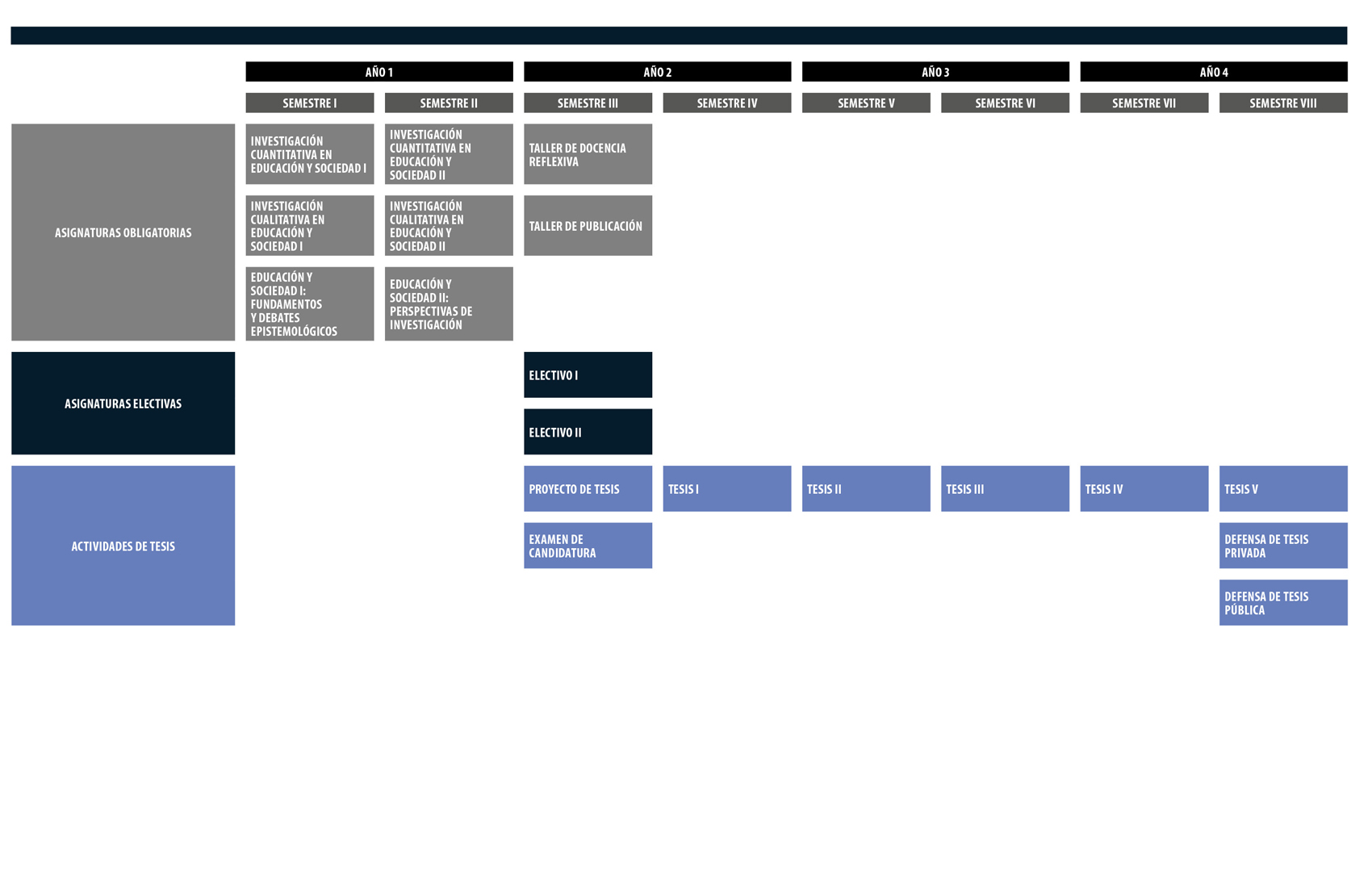
Program Curriculum
Ph.D. Program Professors
Patricio Aroca
Ph.D. in Economics, University of Illinois Urbana-Champaign, United States
Research Line: Public Policy in Education
See moreGerardo Bañales
Ph.D. in Psychology, Ramon Llull University, Spain
Research Line: Language, Education, and Society
See moreNiklas Bornhauser
Ph.D. in Philosophy, Complutense University of Madrid, Spain
Research Line: Language, Education, and Society
See morePatricio Cabello
Ph.D. in Social Psychology, Complutense University of Madrid, Spain
Research Line: Well-Being and Social-Emotional Education
See moreCristian Céspedes
Ph.D. in Psychology, Health, and Quality of Life, University of Girona, Spain
Research Line: Well-Being and Social-Emotional Education
See moreJorge Chávez
Ph.D. in Psychology, Universitat Autònoma de Barcelona, Spain
Research Line: Public Policy in Education
See moreLuis Felipe de la Vega
Ph.D. in Education Sciences, Pontifical Catholic University of Chile
Research Line: Public Policy in Education
See moreCarla Fardella
Ph.D. in Social Psychology, Universitat Autònoma de Barcelona, Spain
Research Line: Public Policy in Education
See moreCarol Flores
Ph.D. in Public Health, University of Chile
Research Line: Public Policy in Education
See moreSergio Fuentealba-Urra
Ph.D. in Psychology, Health, and Quality of Life, University of Girona, Spain
Research Line: Well-Being and Social-Emotional Education
See moreJaviera García-Meneses
Ph.D. in Psychology, Pontifical Catholic University of Valparaíso, Chile
Research Line: Public Policy in Education
See moreFrano Giakoni
Ph.D. in Sports Sciences, UCAM Catholic University of Murcia, Spain
Research Line: Public Policy in Education
See morePablo González
Ph.D. in Economics, University of Cambridge, United Kingdom
Research Line: Public Policy in Education
See moreSteffanie Kloss
Ph.D. in Linguistics, University of Concepción, Chile
Research Line: Language, Education, and Society
See morePeodair Leihy
Ph.D. in Education, University of Melbourne, Australia
Research Line: Public Policy in Education
See moreGonzalo Maier
Ph.D. in Arts, Radboud University, Netherlands
Research Line: Language, Education, and Society
See moreJonathan Martínez-Líbano
Ph.D. in Clinical and Health Psychology, International Iberoamerican University, Mexico
Research Line: Well-Being and Social-Emotional Education
See moreAndrés Mendiburo
Ph.D. in Psychology, University of the Basque Country, Spain
Research Line: Well-Being and Social-Emotional Education
See moreMichelle Mendoza
Ph.D. in Education, Complutense University of Madrid, Spain
Research Line: Public Policy in Education
See moreJuan Carlos Oyanedel
Ph.D. in Law, King's College London, United Kingdom
Research Line: Well-Being and Social-Emotional Education
See moreRodolfo Paredes
Ph.D. in Biomedical Sciences, University of Chile
Research Line: Public Policy in Education
See moreXimena Poblete
Ph.D. in Education, UCL Institute of Education, United Kingdom
Research Line: Public Policy in Education
See moreMaritza Rosas-Maldonado
Ph.D. in Applied Linguistics, University of Liverpool, United Kingdom
Research Line: Language, Education, and Society
See moreAndrés Rubio
Ph.D. in Psychology, University of Girona, Spain
Research Line: Well-Being and Social-Emotional Education
See moreHugo Simkin
Ph.D. in Psychology, National University of La Plata, Argentina
Research Line: Well-Being and Social-Emotional Education
See moreRené Valdés
Ph.D. in Psychology, Pontifical Catholic University of Valparaíso, Chile
Research Line: Public Policy in Education
See moreFernando Valenzuela
Ph.D. in Sociology, University of Lucerne, Switzerland
Research Line: Public Policy in Education
See moreGabriela Vásquez
Ph.D. in Social Sciences Education, University of Valladolid, Spain
Research Line: Public Policy in Education
See moreLiliana Vásquez-Rocca
Ph.D. in Linguistics, Pontifical Catholic University of Valparaíso, Chile
Research Line: Language, Education, and Society
See moreRodrigo Yañez
Ph.D. in Physical Activity and Sports Sciences, University of León, Spain
Research Line: Public Policy in Education
See moreCollaborating Faculty
Jaime Fauré
Ph.D. in Educational Psychology, University of Barcelona, Spain
Alejandro Pérez
Ph.D. in Education, University of Santiago de Chile
Mauricio Valdivia
Ph.D. in Psychology, Pontifical Catholic University of Argentina, and Ph.D. in Behavior and Personality, University of Barcelona, Spain
Requirements
Applicants to the Ph.D. in Education and Society must hold a bachelor’s or master’s degree in education, the social sciences, the humanities, or a related field. Professionals from other disciplines who have relevant experience in the Program’s field of study may also apply.
A. Application Requirements
Applicants must submit the following documents:
- Application Form (see below). Download and complete it with the requested information.
- Notarized copy of the academic degree certificate*
- Undergraduate transcript
- Undergraduate class-ranking certificate
- If the applicant has completed graduate studies, a notarized copy of the graduate degree certificate and transcript
- Copy of the national identity card (front and back) or digital birth certificate; international applicants without a Chilean identity card may submit a copy of their passport
- Certificate of English proficiency (if available)
- Doctoral Dissertation Proposal (see template)
- Two letters of recommendation sent by the recommenders from their own email addresses to desoc@unab.cl (see template)
* Foreign academic degrees must be equivalent to those specified in the Program Decree. If selected, the applicant must submit to the Ph.D. Program Office all documentation required by the University to complete the enrollment process.


 contact us