
Ph.D. in
Critical Theory and Contemporary Society


Degree
Ph.D. in Critical Theory and Contemporary Society

Duration
8 Semesters

School
Social Sciences

2027 Admission
The 2027 admissions process for this Ph.D. program closed on October 4.
Overview
The Ph.D. in Critical Theory and Contemporary Society (TECSA) offered by the School of Social Sciences is a multidisciplinary initiative developed by a group of researchers from several fields represented at Universidad Andrés Bello: History, Philosophy, Literature, Psychology, and Sociology.
The Program arose from its members’ commitment to fulfilling their role in advancing the development of highly qualified researchers and promoting research in specific areas of the humanities and social sciences, defined through the critical study of questions concerning the individual, embodiment, culture, and the social and political processes of contemporary society.
General Objective
Specific Objectives
The specific objectives of the Program are:
- Establish a space for critical reflection and academically rigorous dialogue among theoretical and methodological perspectives from different disciplines on issues of substantive importance to contemporary societies.
- Institutionalize practices that encourage and support students as they formulate an original research question, objectives, and methodology from a critical perspective on the practices and institutions of contemporary societies.
- Provide opportunities for collective reflection so that students can develop and apply a creative perspective to the most advanced theoretical and methodological debates in the humanities and social sciences, with a view to producing their own synthesis of the disciplines, theories, methods, Research Lines, and thematic areas addressed in the TECSA Ph.D.
- Provide opportunities to develop the skills and tools needed to communicate cutting-edge knowledge clearly, objectively, and precisely, both orally and in writing, using registers appropriate to different audiences and respecting the ethical standards recognized in the field—particularly through articles suitable for national and international publication that enrich understanding of contemporary societies.
Graduate Profile
Graduates of the Ph.D. in Critical Theory and Contemporary Society at Universidad Andrés Bello are researchers who draw on established and cutting-edge theoretical, methodological, and practical knowledge in the humanities and social sciences to problematize and critically analyze key phenomena in contemporary society from relevant disciplinary perspectives. In doing so, they advance the generation of original knowledge within the Research Lines of Politics of the Body; Social and Political Processes; and Culture, Image, and Representation. They also possess the skills to conduct independent, ethical, and responsible research to a high standard of academic excellence and to communicate their findings to both specialized and general audiences.
Upon completing the Program, graduates of the Ph.D. in Critical Theory and Contemporary Society will be able to:
- Integrate theoretical, methodological, and practical knowledge from disciplines in the humanities and social sciences to address key issues in contemporary society through problematization and critical analysis.
- Generate original knowledge in the humanities and social sciences through independently conducted research that complies with the scientific community’s ethical standards and is grounded in rigorous and appropriate theoretical and methodological approaches within the Research Lines of Politics of the Body; Social and Political Processes; and Culture, Image, and Representation.
- Communicate research findings orally and in writing to specialized and general audiences using academic registers appropriate to the humanities and social sciences.
Program Research Lines
This Research Line identifies and analyzes the processes that currently shape forms of communication and entertainment in society, explaining how they changed with the advent of modernity and subsequently with the digital age. It also examines the effects of these practices on both individuals and society, including how they alter patterns of behavior and the ways in which relationships with others are understood.
This Research Line examines the principal sociopolitical processes that characterize the contemporary world, analyzing both the social structures in which they are embedded and the actors who shape them. Particular attention is given to the construction and deconstruction of the state and to the role played by conventional and nonconventional political actors. From an interdisciplinary perspective, the Research Line also seeks to identify and assess equality and inequality, as well as conflict, social cohesion, and violence, through sociological, political, economic, territorial, and gender-based perspectives.
This Research Line problematizes the place and status of the body in modernity, with particular attention to the dynamics through which it acquires meaning and functions. In the context of contemporary societies, it analyzes key debates concerning the body, its functions, and related practices, focusing especially on questions involving its characterization and socialization, as well as its meanings and representations. From a critical perspective, it examines the body’s possibilities and limitations within the tension between disciplinary knowledge generated by the imperative to understand it, on the one hand, and the practices associated with its construction and management, on the other.
Culture, Image, and Representation
This Research Line identifies and analyzes the processes that currently shape forms of communication and entertainment in society, explaining how they changed with the advent of modernity and subsequently with the digital age. It also examines the effects of these practices on both individuals and society, including how they alter patterns of behavior and the ways in which relationships with others are understood.
Social and Political Processes
This Research Line examines the principal sociopolitical processes that characterize the contemporary world, analyzing both the social structures in which they are embedded and the actors who shape them. Particular attention is given to the construction and deconstruction of the state and to the role played by conventional and nonconventional political actors. From an interdisciplinary perspective, the Research Line also seeks to identify and assess equality and inequality, as well as conflict, social cohesion, and violence, through sociological, political, economic, territorial, and gender-based perspectives.
Politics of the Body
This Research Line problematizes the place and status of the body in modernity, with particular attention to the dynamics through which it acquires meaning and functions. In the context of contemporary societies, it analyzes key debates concerning the body, its functions, and related practices, focusing especially on questions involving its characterization and socialization, as well as its meanings and representations. From a critical perspective, it examines the body’s possibilities and limitations within the tension between disciplinary knowledge generated by the imperative to understand it, on the one hand, and the practices associated with its construction and management, on the other.
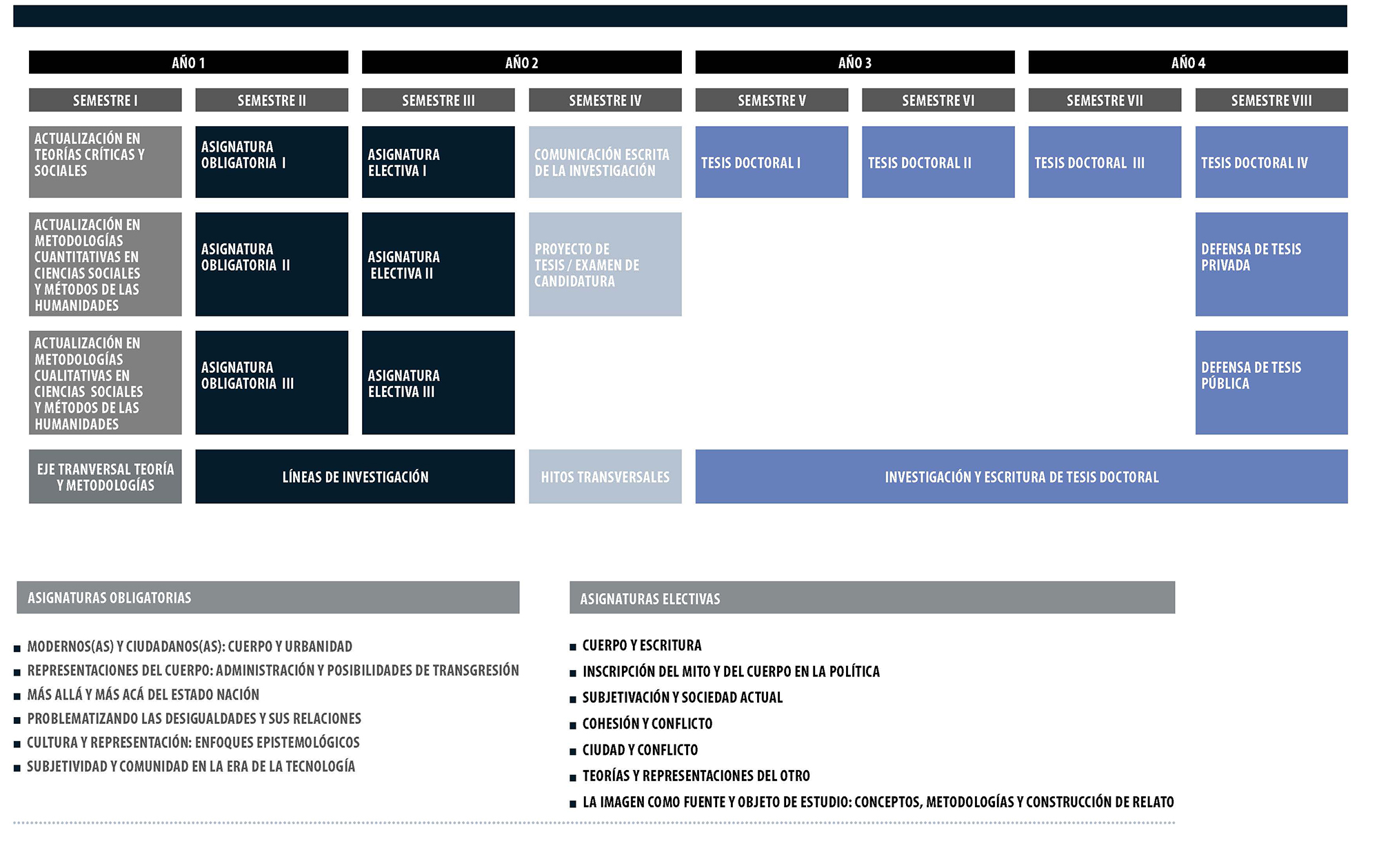
Program Curriculum
Ph.D. Program Professors
Stéphanie Alenda
Ph.D. in Sociology, Université de Lille I, France
Research Area: Political sociology, focusing on right-wing politics, disruptive leadership, and new forms of radicalism. Director of the CRISPOL Millennium Nucleus (since 2024).
salenda@unab.cl See moreMauro Basaure
Ph.D. in Philosophy, Goethe University Frankfurt, Germany
Research Area: Critical theory and political sociology, focusing on recognition, emotions, social suffering, and democracy; the public sphere, populism, and social conflict.
phd.tecsa@unab.cl See moreSolene Bergot
Ph.D. in History, Université Paris 1 Panthéon-Sorbonne and Pontifical Catholic University of Chile, France/Chile
Research Area: Social and cultural history of Chile, focusing on gender, elites, and everyday life; art, visual culture, and digital humanities.
solene.bergot@unab.cl See moreNiklas Bornhauser
Ph.D. in Philosophy, Complutense University of Madrid, Spain
Research Area: Psychoanalysis and critical theory, focusing on memory and subjectivity; cultural studies and contemporary political thought.
nbornhauser@unab.cl See morePatricio Cabello
Ph.D. in Social Psychology, Complutense University of Madrid, Spain
Research Area: Education and collaborative learning, focusing on teacher professional development; improvement of education systems and teaching practices.
patricio.cabello@unab.cl See moreBorja Castro
Research Area: Philosophy of alterity, ethics, and politics in French thought; institutional and organizational analysis; quality of life, poverty, and mental health.
Research Area: Philosophy of alterity, ethics, and politics in French thought; institutional and organizational analysis; quality of life, poverty, and mental health.
francisco.castro@unab.cl See moreMaría José Correa
Ph.D. in History, University College London, United Kingdom.
Research Area: History of science and medicine in Chile, focusing on health, psychiatry, hygiene, and everyday life; scientific culture, the body, and social control.
maria.correa@unab.cl See moreMaría Alejandra Energici
Ph.D. in Sociology, Universidad Alberto Hurtado, Chile
Research Area: Sociology of the body, gender, and subjectivity, focusing on body-based discrimination and critical social psychology; everyday aesthetics and new materialisms.
maria.energici@unab.cl See moreTomás Errázuriz
Ph.D. in Architecture and Urban Studies, Pontifical Catholic University of Chile
Research Area: Material culture and everyday life; urban studies, focusing on sustainability and relationships among people, objects, and domestic spaces.
tomas.errazuriz@unab.cl See moreCarla Fardella
Ph.D. in Social Psychology, Universitat Autònoma de Barcelona, Spain
Research Area: Sociology and social psychology of academic work, focusing on higher education and critical studies of the contemporary university.
carla.fardella@unab.cl See moreStefanie Massmann
Ph.D. in Literature, Pontifical Catholic University of Chile
Research Area: Colonial and Latin American literature, focusing on written culture and representations of territory and empire; cultural history and literary criticism.
smassmann@unab.cl See moreAndrés Mendiburo
Ph.D. in Psychology, University of the Basque Country, Spain
Research Area: Political humor and satire, focusing on public trust and perceptions of leadership; social attitudes and psychological processes underlying human behavior.
andres.mendiburo@unab.cl See moreFernanda Moraga
Ph.D. in Literature, University of Chile
Research Area: Poetry by Chilean and Mapuche women, feminisms, and gender studies; memory, the body, borders, and Latin American literature.
sofia.moraga@unab.cl See moreSebastián Rojas
Ph.D. in Sociology, King’s College London, United Kingdom
Research Area: Subjectivity, mental health, and education, focusing on childhood, care, and medicalization; critical theory and social studies of health.
sebastian.rojas.n@unab.cl See moreFernando Valenzuela
Ph.D. in Sociology, University of Lucerne, Switzerland
Research Area: Sociology of science, health, and technology, focusing on the social construction of knowledge and interventions on the body; social theory and performativity.
fernando.valenzuela@unab.cl See moreLuis Valenzuela
Ph.D. in Literature, Pontifical Catholic University of Chile
Research Area: Contemporary Chilean narrative, film, and literature, focusing on representations of the image and the residual; memory, marginality, and cultural criticism.
luis.valenzuela.p@unab.cl See moreCollaborating Faculty
Javiera Errázuriz
Ph.D. in Contemporary History, Autonomous University of Madrid and Pontifical Catholic University of Chile
Research Area: History of mental health and psychiatry in Chile, focusing on childhood, trauma, and political violence; memory, emotions, and human rights.
javiera.errazuriz@unab.cl See moreJaviera García-Meneses
Ph.D. in Psychology, Pontifical Catholic University of Valparaíso, Chile
Research Area: Social psychology and public policy, focusing on child protection and the well-being of children and adolescents; evidence generation to address social issues.
javiera.garcia@unab.cl See moreFrancisco Orrego
European Ph.D. in Early Modern History, Complutense University of Madrid, Spain
Research Area: Contemporary philosophy and critical theory, focusing on phenomenology, hermeneutics, and political thought; subjectivity, ethics, and modernity.
francisco.orrego@unab.cl See moreNatalia Urra
Ph.D. in Early Modern History (16th–18th centuries), Autonomous University of Madrid, Spain
Research Area: Feminisms, critical theory, and cultural studies, focusing on gender, affect, and subjectivity; violence, the body, and contemporary cultural production.
natalia.urra@unab.cl See moreCamila Véliz
Ph.D. in Social Work, National University of La Plata, Argentina
Research Area: Professional trajectories and groups, focusing on the disciplinary formation of social work; critical history and the discipline’s historical transformations.
karyn.veliz@unab.cl See moreRequirements
Applicants to the Ph.D. in Critical Theory and Contemporary Society must hold a bachelor’s or master’s degree in a humanities or social sciences discipline, or a professional degree whose level, content, and duration are equivalent to those of a bachelor’s degree awarded by the University.
A. Application Requirements
Applicants must submit the following documents:
- Application Form (see template). Download and complete it with the requested information.
- Notarized copy of the academic degree certificate*
- Undergraduate transcript
- Undergraduate class-ranking certificate
- If the applicant has completed graduate studies, a copy of the degree certificate and transcript
- Copy of both sides of the Chilean national identity card or a digital birth certificate; international applicants without a Chilean national identity card may submit a copy of their passport.
- Curriculum Vitae
- Statement of Purpose describing the applicant’s interests and reasons for applying to this Program and the University
- Preliminary dissertation proposal (maximum 6,000 characters).
- Two recommendation letters sent by the recommenders from their email accounts to phd.tecsa@unab.cl
- Written work: accepted or published (preferred)
- English proficiency (reading comprehension). Certificate of English proficiency (preferred)
Shortlisted applicants will be invited to a personal interview with the Selection Committee. They must submit a notarized copy of their professional degree certificate and/or academic degree certificate* and a digital photograph that includes their Chilean national identification number (RUT).
The application evaluation criteria are set forth in Articles 14, 15, and 16 of the Current Internal Regulations, available on the Program website.
* Academic degrees earned abroad must be equivalent to those specified in the Program Decree. If selected, the applicant must submit all documentation required by the University to the Ph.D. Program Office in order to proceed with enrollment.


 contact us