
Ph.D. in
Advanced Systems Engineering


Degree
Ph.D. in Advanced Systems Engineering

Duration
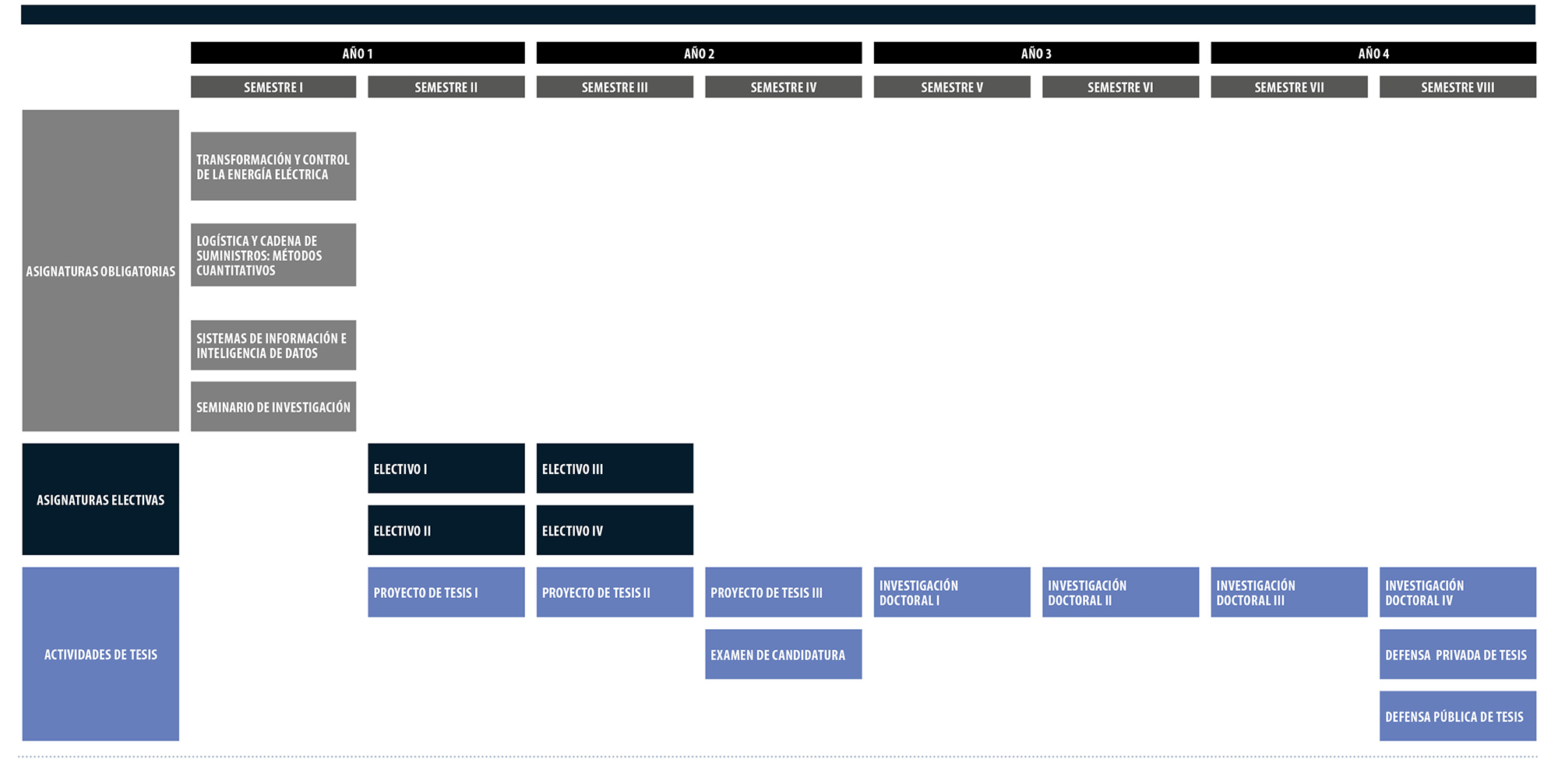
8 Semesters

School
Engineering

2027 Admission
The 2027 admissions process for this Ph.D. program closed on October 4.
Overview
Advanced systems engineering is a paradigm centered on the agile, efficient, iterative, and high-quality development of complex systems using modern digital technologies and tools. These tools make it possible to specify, model, test, simulate, and analyze the system under development within a coherent and consistent methodology. The Ph.D. in Advanced Systems Engineering draws on this paradigm to generate knowledge that addresses challenges facing industry and society. This commitment to generating knowledge connected to the relevant needs of the surrounding environment is shared by both Universidad Andrés Bello and the School of Engineering.
General Objective
The program goal is to train independent researchers with critical analytical skills and a strong foundation in the scientific and technological knowledge associated with developing tools for advanced systems engineering, enabling them to address challenges facing industry and society through high-level research in the Program areas.
Specific Objectives
The specific Program goals are:
- Prepare students to develop and apply tools based on knowledge in Information Systems and Data Intelligence, Electrical Energy Conversion and Control, and/or Logistics and Supply Chain Management, for advanced systems engineering.
- Develop analytical and critical-thinking skills for generating knowledge by designing and conducting research projects that address advanced systems engineering problems sustainably, independently, responsibly, and ethically.
- Provide opportunities to develop and/or strengthen skills in research-based technology and knowledge transfer to address challenges facing industry and/or society.
- Develop the ability to communicate research findings effectively, both orally and in writing, to the scientific community, industry, and society.
Graduate Profile
Graduates of the Ph.D. in Advanced Systems Engineering at Universidad Andrés Bello have a strong foundation in scientific and technological knowledge within the Research Lines of Information Systems and Data Intelligence, Electrical Energy Conversion and Control, and/or Logistics and Supply Chain Management.
They possess the analytical, critical-thinking, and communication skills required to conduct independent research and transfer findings in advanced systems engineering to address challenges facing industry and society, thereby contributing responsibly and ethically to scientific output.
Accordingly, alumni of theDr.Eng. in Advanced Systems program are able to:
- Generate new knowledge by designing and conducting research projects that address advanced systems engineering problems sustainably, responsibly, and ethically.
- Develop tools and/or solutions based on knowledge in Information Systems and Data Intelligence, Electrical Energy Conversion and Control, and/or Logistics and Supply Chain Management, for advanced systems engineering.
- Exhibit skill in research-based technology and knowledge transfer to address challenges facing industry and/or society.
- Communicate research findings effectively, both orally and in writing, to the scientific community, industry, and society.
Program Research Lines
Information Systems are constantly evolving because of their widespread adoption in industry and society, together with advances in areas such as sensors, artificial intelligence, big data, communications, computing, and social media. This evolution has rapidly increased system complexity and created challenges that include managing large volumes of data, developing advanced intelligent algorithms, and ensuring interoperability, efficiency, and quality. This Research Line focuses on the research and development of methods, techniques, models, and/or algorithms for creating new and/or improved information systems that enable intelligent management of the data required in different application domains. Its purpose is to generate and transfer knowledge that can address technological challenges in areas such as energy, logistics, health, and education.
Electrical Energy Conversion systems play a fundamental role in processes that use and/or generate energy by enabling this resource to be converted and used efficiently under controlled conditions. This Research Line therefore seeks to address emerging energy challenges by generating new knowledge on electrical energy conversion and management systems and proposing new control methods and electrical architectures that support an effective transition toward clean energy. In this context, the Research Line examines the design and control of power converters, renewable energy sources, energy storage systems, electromobility, and electric power systems, among other topics related to energy conversion and control.
Logistics and Supply Chain Management play a fundamental role in the effective operation of production and service systems. This Research Line provides the knowledge and methodological tools needed to address emerging technological, sustainability, and digital-integration challenges in engineering systems. It focuses on comprehensive supply chain management and decision-making grounded in fundamental and applied research. Techniques, methods, and tools in optimization, simulation, econometrics, stochastic modeling, analytics, and data science, among others, are developed, implemented, and applied. This work addresses problems arising in transportation, logistics, production systems, risk analysis, and the various components that define the supply chain.
Information Systems and Data Intelligence
Information Systems are constantly evolving because of their widespread adoption in industry and society, together with advances in areas such as sensors, artificial intelligence, big data, communications, computing, and social media. This evolution has rapidly increased system complexity and created challenges that include managing large volumes of data, developing advanced intelligent algorithms, and ensuring interoperability, efficiency, and quality. This Research Line focuses on the research and development of methods, techniques, models, and/or algorithms for creating new and/or improved information systems that enable intelligent management of the data required in different application domains. Its purpose is to generate and transfer knowledge that can address technological challenges in areas such as energy, logistics, health, and education.
Electrical Energy Conversion and Control
Electrical Energy Conversion systems play a fundamental role in processes that use and/or generate energy by enabling this resource to be converted and used efficiently under controlled conditions. This Research Line therefore seeks to address emerging energy challenges by generating new knowledge on electrical energy conversion and management systems and proposing new control methods and electrical architectures that support an effective transition toward clean energy. In this context, the Research Line examines the design and control of power converters, renewable energy sources, energy storage systems, electromobility, and electric power systems, among other topics related to energy conversion and control.
Logistics and Supply Chain Management
Logistics and Supply Chain Management play a fundamental role in the effective operation of production and service systems. This Research Line provides the knowledge and methodological tools needed to address emerging technological, sustainability, and digital-integration challenges in engineering systems. It focuses on comprehensive supply chain management and decision-making grounded in fundamental and applied research. Techniques, methods, and tools in optimization, simulation, econometrics, stochastic modeling, analytics, and data science, among others, are developed, implemented, and applied. This work addresses problems arising in transportation, logistics, production systems, risk analysis, and the various components that define the supply chain.
Program Curriculum
Ph.D. Program Professors
Daniel Aguayo
Ph.D. in Applied Sciences, University of Talca, Chile
Research Line: Information Systems and Data Intelligence
daniel.aguayo@unab.cl See moreHernán Astudillo
Ph.D. in Information and Computer Science, Georgia Institute of Technology, United States
Research Line: Information Systems and Data Intelligence
hernan.astudillo@unab.cl See moreCarola Blázquez
Ph.D. in Geospatial Information Engineering, University of Wisconsin-Madison, United States
Research Line: Logistics and Supply Chain Management
cblazquez@unab.cl See moreNicolás Bronfman
Ph.D. in Engineering, Pontifical Catholic University of Chile
Research Line: Logistics and Supply Chain Management
nbronfman@unab.cl See moreFreddy Flores
Ph.D. in Electronic Engineering, Universitat Rovira i Virgili, Spain
Research Line: Electrical Energy Conversion and Control
freddy.flores@unab.cl See moreGustavo Gatica
Ph.D. in Engineering with a specialization in Automation, University of Santiago, Chile
Research Line: Logistics and Supply Chain Management
ggatica@unab.cl See moreJuan Sebastián Gómez
Ph.D. in Electrical Engineering, University of Chile
Research Line: Electrical Energy Conversion and Control
juan.gomez@unab.cl See moreCatalina González
Ph.D. in Technologies for Nanosystems, Bioengineering, and Energy, Universitat Rovira i Virgili, Spain
Research Line: Electrical Energy Conversion and Control
catalina.gonzalez@unab.cl See moreArmin Lüer
Ph.D. in Engineering, Pontifical Catholic University of Chile
Research Line: Logistics and Supply Chain Management
armin.luer@unab.cl See moreGonzalo Méndez
Ph.D. in Engineering, Pontifical Catholic University of Chile
Research Line: Logistics and Supply Chain Management
gonzalo.mendez@unab.cl See moreOrietta Nicolis
Doctor in Applied Statistics, University of Padua, Italy
Research Line: Information Systems and Data Intelligence
orietta.nicolis@unab.cl See moreBilly Peralta
Ph.D. in Computer Science, Pontifical Catholic University of Chile
Research Line: Information Systems and Data Intelligence
billy.peralta@unab.cl See moreCarla Taramasco
Doctor in Humanities and Social Sciences, École Polytechnique, France
Research Line: Information Systems and Data Intelligence
carla.taramasco@unab.cl See moreLuca Tarisciotti
Ph.D. in Electrical and Electronic Engineering, University of Nottingham, United Kingdom
Research Line: Electrical Energy Conversion and Control
luca.tarisciotti@unab.cl See moreJuan Pablo Vásconez
Ph.D. in Electronic Engineering, Federico Santa María Technical University, Chile
Research Line: Information Systems and Data Intelligence
juan.vasconez@unab.cl See moreAlan Wilson
Ph.D. in Electrical Engineering, TU Dresden, Germany
Research Line: Electrical Energy Conversion and Control
alan.wilson@unab.cl See moreCollaborating Faculty
Juan Felipe Calderón
Ph.D. in Engineering with Computer Science specialization, Pontifical Catholic University of Chile
See moreRaquel Jiménez
Ph.D. in Environmental Health, Boston University School of Public Health, United States
See moreJavier Pereira
Doctor in Management Sciences, Paris Dauphine University, France
David Ruete
Ph.D. in Multimedia, Technology, and Networking, Atlantic International University, United States
See moreFrancisco Yuraszeck
Ph.D. in Industrial Engineering, Pontifical Catholic University of Valparaíso, Chile
See moreRequirements
A. Application Requirements
Applicants to the Ph.D. in Advanced Systems Engineering must hold a bachelor’s or master’s degree in engineering sciences, physical sciences, mathematics, or another discipline related to the Program, as determined by the Academic Committee. They must also demonstrate outstanding academic performance through certificates and other academic records.
Applicants must submit the following documents:
- Application Form (see template below). Download and complete it with the requested information.
- Notarized copy of the academic degree certificate*
- Undergraduate academic transcript
- Undergraduate class-ranking certificate
- If the applicant has completed graduate studies, a notarized copy of the degree certificate and the corresponding academic transcript
- Copy of the Chilean national identification card (both sides) or a digital birth certificate. International applicants without a Chilean national identification card may submit a copy of their passport.
- Curriculum Vitae
- Statement of Purpose describing the applicant’s interests and reasons for applying to this Program and Universidad Andrés Bello
- Research proposal in one of the Program Research Lines (see template)
- Two letters of recommendation sent by each recommender from their email address to hernan.astudillo@unab.cl (see template)
* Academic degrees earned outside Chile must be equivalent to those specified in the Program Decree. If selected, the applicant must submit to the Ph.D. Program Office all documentation required by the University to complete the enrollment process..


 contact us