
Ph.D. in
Applied Humanities

Degree
Ph.D. in Applied Humanities

Duration
8 Semesters

School
Education and Humanities

2027 Admission
The 2027 admissions process for this Ph.D. program closed on October 4.
Overview
The Ph.D. in Applied Humanities is a multidisciplinary initiative of the Department of Humanities within the Faculty of Education and Humanities at Universidad Andrés Bello. It is grounded in the conviction that the humanities can contribute to the areas undergoing the greatest transformation in contemporary society and can broaden the reach of their scholarship and resources to diverse audiences.
General Objective
Specific Objectives
The specific objectives of the Program are:
- Prepare students to conduct independent and original research that contributes directly to the understanding of contemporary society and meets academic, ethical, and scientific standards.
- Provide students with theoretical, methodological, and communication tools that enable them to apply their knowledge and skills to the challenges of contemporary society in scientific and technological, political and economic, and visual culture and territorial contexts.
- Contribute to the creation and dissemination of new multidisciplinary knowledge in the applied humanities through research and scholarly publications and by communicating this work to specialized and general audiences.
- Promote critical reflection on issues relevant to the Program Research Lines through opportunities for cooperation and academic dialogue at the national and/or international level.
Graduate Profile
Graduates of the Ph.D. in Applied Humanities have methodological and theoretical training in the humanities, drawing on history, literature, and philosophy to approach the problems of contemporary society critically and creatively through scientific and technological humanities, political and economic humanities, and visual and territorial humanities.
They possess the knowledge and skills to conduct independent and original research within the Program Research Lines in accordance with ethical standards and to disseminate and apply their findings to society’s needs and challenges in academic settings and diverse professional contexts.
The expected learning outcomes are:
- Demonstrate critical reflection on the Program Research Lines by participating in academic dialogue at the national and/or international level.
- Conduct original research using theoretical and methodological tools, knowledge, and skills related to the applied humanities to address issues facing contemporary society.
- Independently produce humanities research outputs applicable to the needs and challenges of contemporary society in the following Research Lines: Scientific and Technological Humanities, Political and Economic Humanities, and Visual and Territorial Humanities.
- Communicate research findings effectively, responsibly, and ethically through different formats to specialized and general audiences.
Program Research Lines
Scientific and Technological Humanities
Political and Economic Humanities
Visual and Territorial Humanities
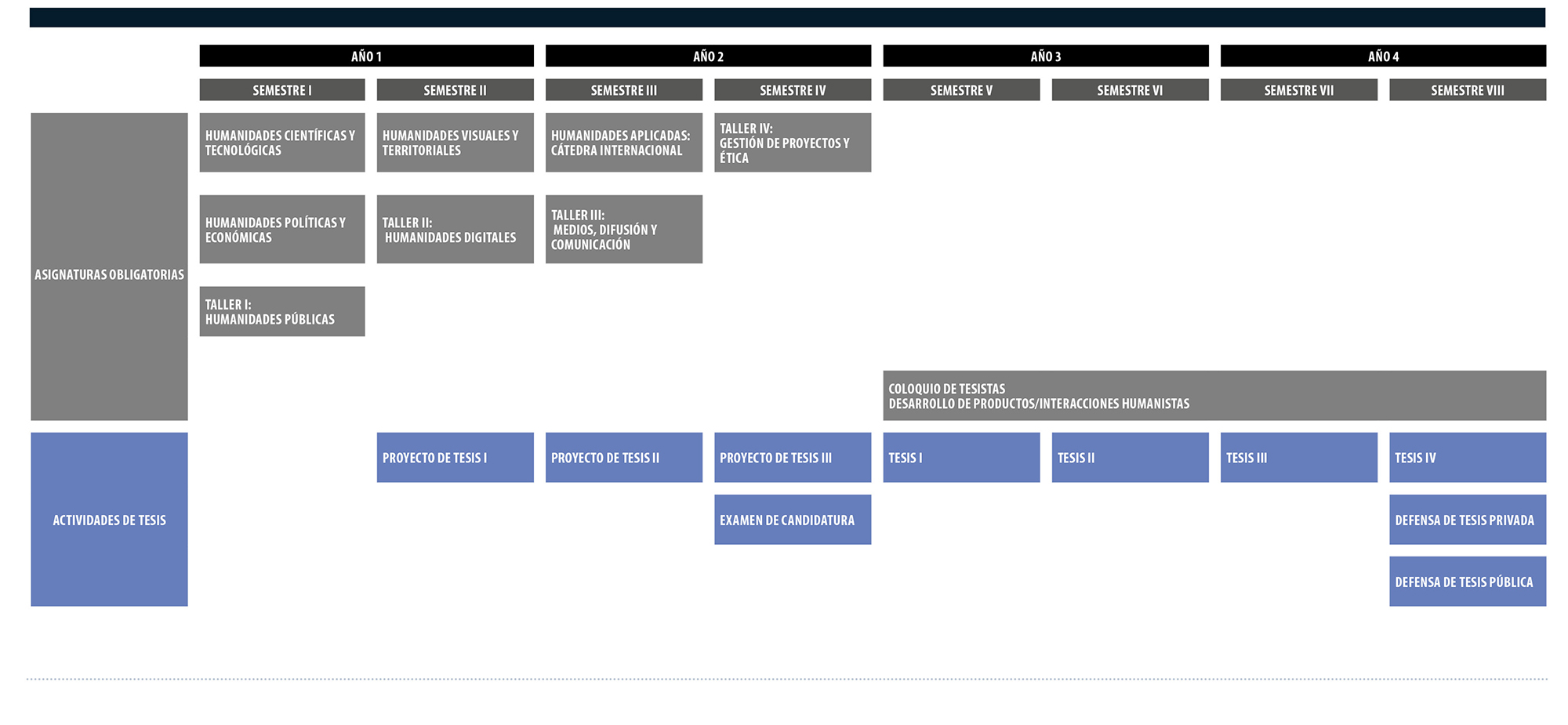
Program Curriculum
Ph.D. Program Professors
Solene Bergot
Ph.D. in History, Université Paris 1 Panthéon-Sorbonne and Pontifical Catholic University of Chile, France/Chile
Research Line: Cultural history of Chile, childhood studies, and art history. She also develops initiatives in the digital humanities.
solene.bergot@unab.cl See moreJorge Cáceres
Ph.D. in Literature, Pontifical Catholic University of Valparaíso, Chile
Research Line: Latin American literature and its connections to identity and memory.
jorge.caceres@unab.cl See moreBorja Castro
Ph.D. in Philosophy, University of Murcia, Spain
Research Line: Philosophy of alterity and institutional analysis; critical perspectives on the concept of social intervention and social policies concerning poverty and mental health.
francisco.castro@unab.cl See moreDiego Castro
Ph.D. in Philosophy, University of Groningen, the Netherlands
Research Line: Argumentation theory, critical thinking, logic, epistemology, and rhetoric.
diego.castro@unab.cl See moreMaría José Correa
Ph.D. in History, Wellcome Trust Centre for the History of Medicine at University College London, United Kingdom
Research Line: History of science and medicine in Chile from a cultural perspective, gender issues, and heritage.
maria.correa@unab.cl See moreJaviera Errázuriz
Ph.D. in Contemporary History, Autonomous University of Madrid and Pontifical Catholic University of Chile, Spain/Chile
Research Line: Political and cultural processes in Chile from a historical perspective, with a focus on women's history, gender, and childhood.
javiera.errazuriz@unab.cl See moreTomás Errázuriz
Ph.D. in Architecture and Urban Studies, Pontifical Catholic University of Chile
Research Line: Cities, territory, and visual culture; intersections between material culture and everyday life.
tomas.errazuriz@unab.cl See moreDaniel Fauré
Ph.D. in History, University of Chile
Research Line: Political and cultural history of Chile, specializing in public history and memory.
daniel.faure@unab.cl See moreGonzalo Maier
Ph.D. in Arts, Radboud University, the Netherlands
Research Line: Irony in literature, parody, and the relationship between writing, affect, and creative processes.
gonzalo.maier@unab.cl See moreStefanie Massmann
Ph.D. in Literature, Pontifical Catholic University of Chile
Research Line: Colonial literature, with an emphasis on subjectivity, postcolonialism, and geographical imaginaries.
smassmann@unab.cl See moreFernanda Moraga
Ph.D. in Literature, University of Chile
Research Line: Women's poetry, decolonial feminisms, embodiment, and literary and artistic boundaries.
sofia.moraga@unab.cl See moreDaniel Nieto
Ph.D. in History, Pontifical Catholic University of Valparaíso, Chile
Research Line: Ancient Greco-Roman history, classical reception in Latin America, and historiography.
daniel.nieto@unab.cl See moreFrancisco Orrego
European Doctorate in Modern History, Complutense University of Madrid, Spain
Research Line: Modern history, cultural history of science, and relationships between knowledge and politics in the Iberian and colonial worlds.
francisco.orrego@unab.cl See moreNicolás Román
Ph.D. in Latin American Studies, University of Chile
Research Line: Latin American literature, cultural studies, and biopolitics.
nicolas.roman@unab.cl See moreNatalia Urra
Ph.D. in Modern History, Autonomous University of Madrid, Spain
Research Line: Modern and colonial history, with an emphasis on the Inquisition, witchcraft, magical practices, and women's history in Ibero-America.
natalia.urra@unab.cl See moreLuis Valenzuela
Ph.D. in Literature, Pontifical Catholic University of Chile
Research Line: Literary criticism and cultural studies, exploring connections among literature, politics, and aesthetics. Digital culture and multimedia.
luis.valenzuela.p@unab.cl See morePaulina Varas
Ph.D. in Art History and Theory, University of Barcelona, Spain
Research Line: Contemporary art, heritage, and visual culture in Chile and Latin America.
paulina.varas.a@unab.cl See moreLiliana Vásquez-Rocca
Ph.D. in Linguistics, Pontifical Catholic University of Valparaíso, Chile
Research Line: Linguistics, language, and communication, including multimodal and multimedia dimensions.
liliana.vasquez@unab.cl See moreCollaborating Faculty
Niklas Bornhauser
Ph.D. in Philosophy, Complutense University of Madrid, Spain
Claudio Broitman
Ph.D. in Information and Communication Sciences, Université Paris-Sorbonne, France
Osvaldo Carvajal
Ph.D. in Literature, University of Chile
Gustavo Cataldo
Honorary Professor. Philosopher, Pontifical Catholic University of Valparaíso
Ruth Espinosa
Ph.D. in Philosophy, Leipzig University, Germany
Beatriz Mella
Ph.D. in Urban Planning, University College London, London
Sebastián Rojas
Ph.D. in Sociology, King's College London, London
Requirements
A. Application Requirements
Applicants to the Ph.D. in Applied Humanities must hold a master’s or bachelor’s degree in the humanities or a related discipline. Professionals from other disciplines must have relevant, documented experience in the Program’s field of study. A master’s degree is preferred.
Applicants must submit the following documents:
- Application Form (see template). Download and complete it with the requested information.
- Notarized copy of the academic degree certificate*
- Undergraduate academic transcript
- Undergraduate class-ranking certificate
- If the applicant has completed graduate studies, a notarized copy of the degree certificate and the corresponding academic transcript
- Copy of the Chilean national identification card (both sides) or a digital birth certificate. International applicants without a Chilean national identification card may submit a copy of their passport.
- Curriculum Vitae
- Statement of Purpose describing the applicant’s interests and reasons for applying to this Program and Universidad Andrés Bello
- Evidence of prior research work (a published academic article, dissertation or thesis, or other written work)
- Doctoral dissertation proposal (see template)
- Two letters of recommendation sent by each recommender from their email address to dha@unab.cl (see template)
* Academic degrees earned outside Chile must be equivalent to those specified in the Program Decree. If selected, the applicant must submit to the Ph.D. Program Office all documentation required by the University to complete the enrollment process.


 contact us