
Ph.D. in
Molecular Physical Chemistry

Degree
Ph.D. in Molecular Physical Chemistry

Duration
8 Semesters

School
Exact Sciences

2027 Admission
The 2027 admissions process for this Ph.D. program closed on September 4.
Presentación
The Ph.D. in Molecular Physical Chemistry is the result of a collaborative effort among faculty members from the School of Exact Sciences at Universidad Andrés Bello. This advanced studies program reflects the School’s mission to promote the development of highly qualified professionals and scientific research at the highest level, contributing to the creation of new knowledge and the advancement of molecular physical chemistry in Chile and internationally.
General Objective
The general objective of the Ph.D. in Molecular Physical Chemistry is to train independent researchers who are prepared to conduct research autonomously, either individually or collaboratively, and generate cutting-edge knowledge in molecular physical chemistry.
Specific Objectives
The program’s specific objectives are:
The advanced studies leading to the degree of Ph.D. in Molecular Physical Chemistry focus specifically on the following objectives:
- To provide advanced and specialized knowledge in molecular physical chemistry, with a focus on identifying and solving problems related to the structure and properties of matter and/or its interaction with electromagnetic radiation.
- To provide academic training that enables graduates to conduct original, independent research that contributes significantly to the advancement of the field or related areas.
Graduate Profile
Graduates of the Ph.D. in Molecular Physical Chemistry at Universidad Andrés Bello possess a solid foundation in the fundamental concepts and principles of Molecular Physical Chemistry, its scope, the current state of the art, and its applications. They also demonstrate command of the theoretical and methodological foundations of scientific research as applied to their field.
Graduates possess the skills needed to understand, analyze, and solve problems. Through the application of the scientific method, these skills enable them to conduct original, independent research on topics related to the structure and properties of matter and/or its interaction with electromagnetic radiation.
Graduates use research methodology to identify, formulate, and solve scientific problems by understanding the concepts and theories that relate molecular structure to the properties of matter as the subject of study. They also receive complementary training in mathematical methods that enables them to deepen their understanding of the concepts and principles of physical chemistry, quantum chemistry, and spectroscopy, as well as their scope, the current state of the art, and their applications.
Furthermore, graduates are equipped to communicate scientific findings to both the academic community and the general public through original reports that contribute to the advancement of Molecular Physical Chemistry across a variety of applications.
Through their disciplinary training and research experience, graduates are prepared to work autonomously and collaboratively as researchers at research centers, higher education institutions, and public- and private-sector organizations, contributing to Chile’s scientific and technological development.
Program Research Areas
Structure and Properties of Matter
Matter–Radiation Interaction
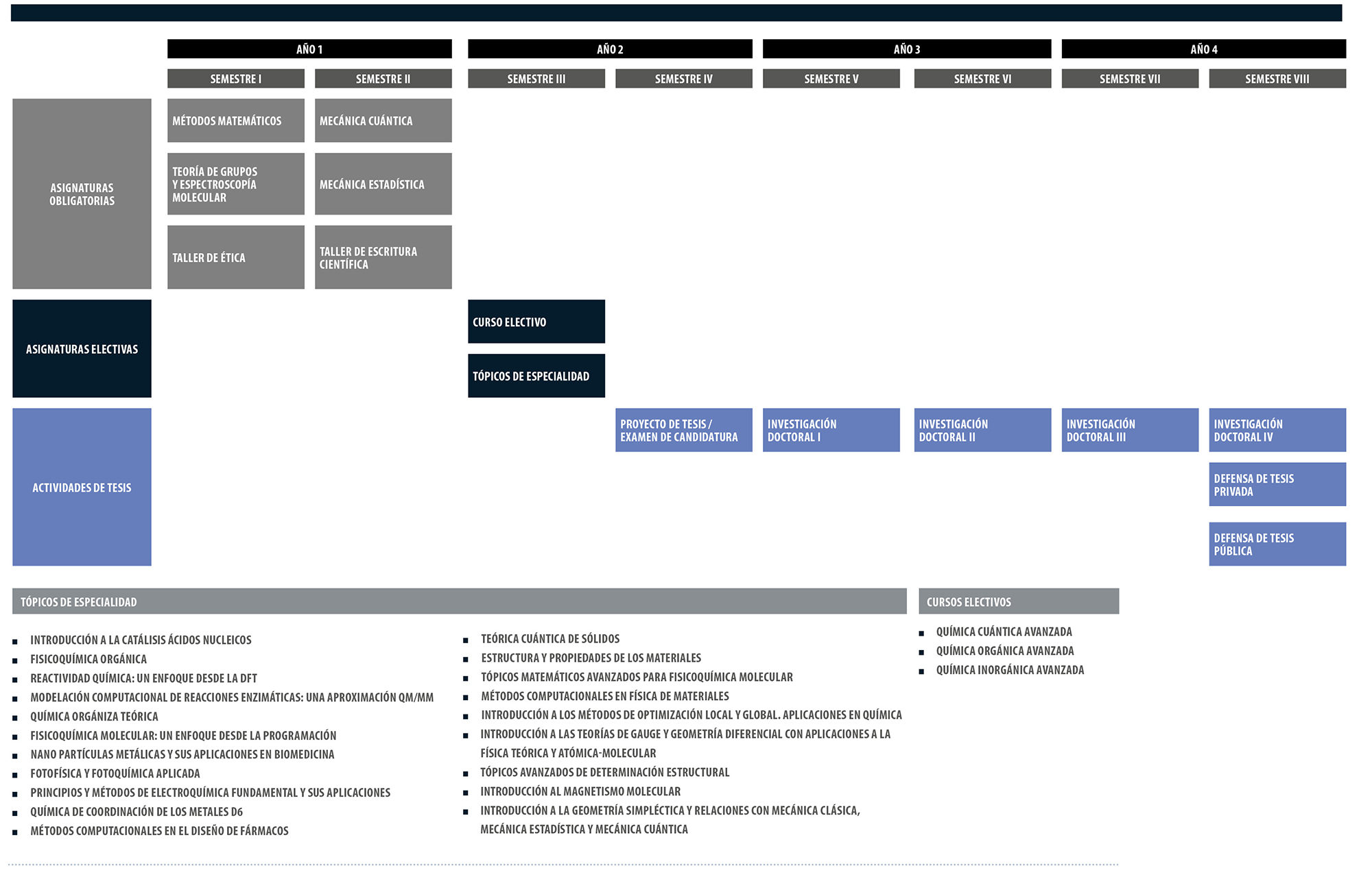
Program Curriculum
Ph.D. Program Professors
Eyleen Araya
Ph.D. in Biotechnology, University of Barcelona, Spain
Research Areas: Nanoparticle synthesis; physicochemical characterization; controlled drug delivery; photothermal therapy; and biological evaluation in advanced cell models.
eyleen.araya@unab.cl See moreRamiro Arratia
Ph.D. in Chemistry, University of California, United States
Research Areas: Relativistic quantum chemistry and its application to materials and clusters.
rarratia@unab.cl See moreAlexander Carreño
Ph.D. in Molecular Physical Chemistry, Universidad Andrés Bello, Chile
Research Areas: Design, synthesis, and characterization of novel d6-metal-based fluorophores for use in walled cell models.
alexander.carreno@unab.cl See moreRafael Islas
Ph.D. in Chemistry, University of Guanajuato, Mexico
Research Areas: Aromaticity and electron delocalization.
rafael.islas@unab.cl See moreGonzalo Jaña
Ph.D. in Science, with a specialization in Chemistry, Universidad de Concepción, Chile
Research Areas: Computational chemistry applied to the study of reaction mechanisms in systems of biological interest.
gonzalo.jana@unab.cl See moreVerónica Jiménez
Ph.D. in Science, with a specialization in Chemistry, Universidad de Concepción, Chile
Research Areas: Computational simulation of supramolecular interactions and reaction mechanisms in systems of biological interest.
veronica.jimenez@unab.cl See moreJorge Martínez
Ph.D. in Chemistry, Pontificia Universidad Católica de Chile
Research Areas: Development of chemical reactivity descriptors; homogeneous catalysis; and molecules of biological and energy interest.
jorge.martinez@unab.cl See moreSebastián Miranda
Ph.D. in Chemistry, Universidad de Chile
Research Lines: Computational catalysis and biophysics.
sebastian.miranda@unab.cl See moreWalter Orellana
Ph.D. in Physical Sciences, University of São Paulo, Brazil
Research Areas: Condensed matter physics; electronic structure of solids; surfaces and nanostructures; surface physical chemistry; and theoretical models in heterogeneous catalysis.
worellana@unab.cl See moreDayán Páez
Ph.D. in Molecular Physical Chemistry, Universidad Andrés Bello, Chile
Research Areas: Relativistic molecular physical chemistry; photophysical properties; and molecular magnetism.
dayan.paez@unab.cl See moreVerónica Paredes
Ph.D. in Chemistry, Universidad de Chile
Research Areas: Polyfunctional coordination polymers; polymetallic inorganic materials; and molecular magnetism.
vparedes@unab.cl See moreNancy Pizarro
Ph.D. in Chemistry, Universidad de Chile
Research Areas: Photochemistry and photophysics of inorganic, organic, and organometallic materials.
npizarro@unab.cl See moreSebastián Reyes-Lillo
Ph.D. in Physics, Rutgers University, United States
Research Areas: First-principles study of hexagonal strain for materials design and the discovery of new phenomena.
sebastian.reyes@unab.cl See moreWilliam Tiznado
Ph.D. in Chemistry, Universidad de Chile
Research Areas: Theoretical study of atomic clusters; chemical bonding analysis; and hybrid conformational search algorithms.
wtiznado@unab.cl See moreCecilia Torres
Ph.D. in Science, with a specialization in Chemistry, Universidad de Concepción, Chile
Research Areas: Synthesis of nanostructured materials and metallic nanoparticles with potential applications in catalysis and biomedicine.
cecilia.torres@unab.cl See moreAndrés Vega
Ph.D. in Chemistry, Universidad de Chile
Research Areas: Preparation and structural characterization of inorganic compounds; electronic structure of organometallic compounds; and X-ray diffraction.
andresvega@unab.cl See moreCollaborating Faculty
Roxana Arce
Ph.D. in Chemistry, Universidad de Santiago de Chile
Marjorie Cepeda
Ph.D. in Chemistry, Pontificia Universidad Católica de Chile
Mario Duque
Ph.D. in Molecular Physical Chemistry, Universidad Andrés Bello
Mauricio González
Ph.D. in Molecular Physical Chemistry, Universidad Andrés Bello
Daniel Pons
Ph.D. in Mathematics, Imperial College London, University of London, United Kingdom
Requirements
Applicants to the Ph.D. in Molecular Physical Chemistry must hold a Bachelor’s or Master’s degree, or an equivalent degree, in chemistry, physics, biochemistry, or a related discipline. The curricular requirements of programs leading to a professional degree must be equivalent to or more rigorous than those of a bachelor’s degree.
A. Application Requirements
Applicants must submit the following documents:
- Application Form (see template). Download and complete it with the requested information.
- Notarized copy of the academic degree certificate*
- Undergraduate transcript
- Undergraduate class ranking certificate
- If the applicant has completed graduate studies, a notarized copy of the degree certificate and the corresponding transcript.
- Copy of both sides of the Chilean identity card or a digital birth certificate. International applicants who do not have a Chilean identity card may submit a copy of their passport.
- A letter describing the applicant’s interests and reasons for applying to this program and Universidad Andrés Bello
- If the applicant has published scientific articles, copies must be attached.
- Two recommendation letters sent by the recommenders from their own email addresses to dashiell.lizama@unab.cl (see template)
* Applicants holding degrees awarded outside Chile must have qualifications equivalent to those specified in the program decree. Applicants who are selected must submit to the Ph.D. Program Office all documentation required by the University before they may complete the enrollment process.
Applicants will be selected based on the following criteria: academic recommendation letters; undergraduate and/or graduate academic performance; and scientific publications, if any. Scientific publications on topics related to the program will be viewed favorably during candidate selection. The selection process will be based on these explicit criteria and on the weighting system formally established in the program regulations, with the aim of ensuring consistency, transparency, and fairness.
The Admissions Committee will comprise the Academic Committee of the Ph.D. in Molecular Physical Chemistry and any other Program Faculty members invited to participate by the Program Director. Once the interview process has concluded, applicants will be formally notified of the selection results by email.


 contact us