
Ph.D. in
Translational Dentistry

Degree
Ph.D. in Translational Dentistry

Duration
8 Semesters

School
Dentistry

2027 Admission
Apply by September 4, 2026. See the Requirements section.
Overview
The Ph.D. in Translational Dentistry offered by the School of Dentistry at Universidad Andrés Bello promotes research and the adoption of emerging technologies such as bioinformatics and artificial intelligence. These tools make it possible to address complex problems through innovative approaches, improving the effectiveness of dental treatments and positioning graduates at the forefront of dental technology.
The doctoral training provided by this Ph.D. program has a direct impact on quality of life. Advances in research and the development of new techniques can lead to better preventive and therapeutic practices, reducing the burden of oral diseases and improving the community’s overall health.
The Ph.D. in Translational Dentistry plays a key role in advancing research and its clinical application in dentistry. It develops highly qualified professionals, promotes technology transfer and innovation, and strengthens ties between academia and industry, making a significant contribution to improving the population’s oral and overall health.
General Objective
The general objective of the Ph.D. in Translational Dentistry is to provide doctoral education of the highest standard that prepares graduates to address oral and maxillofacial health challenges by designing, conducting, and disseminating original translational research and innovation grounded in a strong scientific and technological foundation. Graduates will also acquire multidisciplinary teamwork tools that enable them to contribute significantly to the advancement of knowledge and technology transfer in dental sciences.
Specific Objectives
The program’s specific objectives are to:
- Provide opportunities to develop skills in searching, organizing, and critically analyzing scientific literature relevant to the field of study, enabling students to identify knowledge gaps and propose original scientific and technological research.
- Promote the development of cognitive, technical, communication, and teamwork skills needed to conduct outstanding multidisciplinary translational research in dental sciences in accordance with fundamental bioethical principles.
- Create opportunities to promote scientific communication and technology transfer in dental sciences through participation in conferences and science and technology events, publication in specialized journals, and the creation of intellectual property.
- Provide students with opportunities for multidisciplinary academic interaction through strategic partnerships with research institutions, hospitals, and the dental industry in Chile and abroad. These partnerships will facilitate learning in real-world settings, access to professional networks, knowledge exchange, and experience in designing and implementing innovative projects.
Graduate Profile
Graduates of the Ph.D. in Translational Dentistry at Universidad Andrés Bello possess strong knowledge of dental sciences, bioinformatics tools, and information systems. This enables them to generate original knowledge and science- and technology-based innovation to address oral and maxillofacial health challenges.
They possess the critical analysis skills needed to conduct translational research independently in either of the following research lines: Maxillofacial Tissue Biology or Host-Pathogen Interactions.
Graduates possess the skills and tools needed to work in academia, clinical settings, or industry, integrating basic research and clinical applications while observing bioethical principles. They are also able to communicate the results of their research and innovation to specialist and non-specialist audiences.
Program Research Areas
This research line examines major human oral and maxillofacial diseases, including periodontitis, head and neck cancer, disorders of the oral mucosa, jawbones, and salivary glands, as well as oral manifestations of systemic diseases and the repair and reconstruction of the maxillofacial skeleton. Its purpose is to investigate the cellular and molecular mechanisms underlying the clinical manifestations of these processes in order to develop new prevention protocols, identify diagnostic markers, and innovate in therapies and follow-up methods based on biotechnology and bioinformatics.
This research line examines interactions between oral pathogens and the host at the molecular, cellular, and systemic levels. This entails evaluating how such interactions affect the development and progression of oral and systemic diseases while also exploring mechanisms for controlling these diseases. Computational and data science tools are used to design new treatments or products and improve clinical processes. The primary purpose is to generate multidisciplinary, science- and technology-based knowledge to address challenges related to oral diseases of infectious origin and develop innovative prevention and treatment strategies.
Maxillofacial Tissue Biology
This research line examines major human oral and maxillofacial diseases, including periodontitis, head and neck cancer, disorders of the oral mucosa, jawbones, and salivary glands, as well as oral manifestations of systemic diseases and the repair and reconstruction of the maxillofacial skeleton. Its purpose is to investigate the cellular and molecular mechanisms underlying the clinical manifestations of these processes in order to develop new prevention protocols, identify diagnostic markers, and innovate in therapies and follow-up methods based on biotechnology and bioinformatics.
Host-Pathogen Interactions
This research line examines interactions between oral pathogens and the host at the molecular, cellular, and systemic levels. This entails evaluating how such interactions affect the development and progression of oral and systemic diseases while also exploring mechanisms for controlling these diseases. Computational and data science tools are used to design new treatments or products and improve clinical processes. The primary purpose is to generate multidisciplinary, science- and technology-based knowledge to address challenges related to oral diseases of infectious origin and develop innovative prevention and treatment strategies.
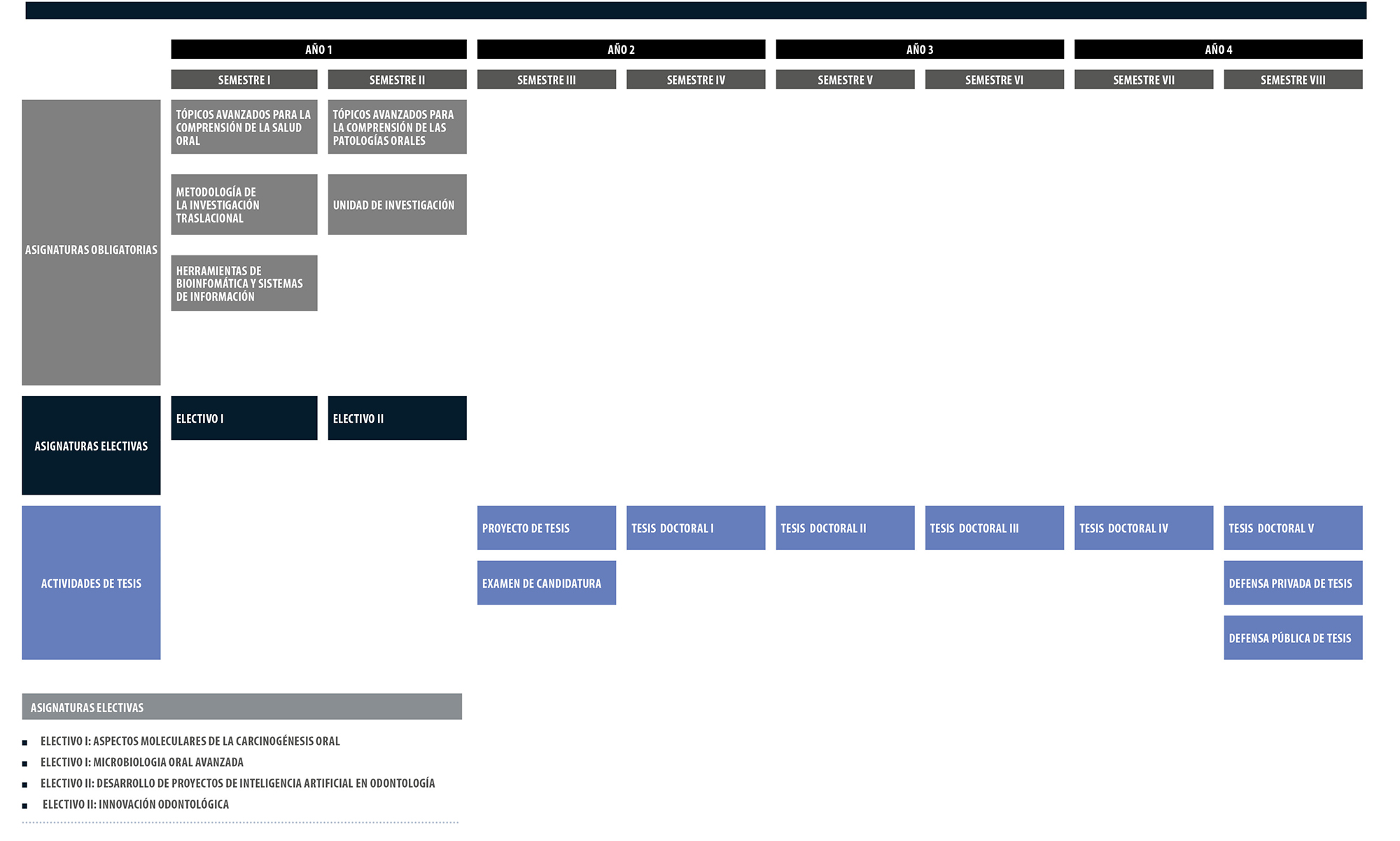
Program Curriculum
Ph.D. Program Professors
Denisse Bravo
Ph.D. in Biochemistry, University of Chile
Research Line: Translational research on the oral microbiota and its impact on systemic diseases and oral cancer.
denisse.bravo@unab.cl See moreFranco Cavalla
Ph.D. in Stomatology and Oral Biology, University of São Paulo, Brazil
Research Line: Alveolar bone regeneration.
ian.cavalla@unab.cl See moreLuis Córdova
Ph.D. in Orthopedic and Bone Research, Nantes Université / Inserm, France
Research Line: Pathophysiology of skeletal remodeling.
luis.cordova@unab.cl See moreVíctor Díaz
Ph.D. in Biological Sciences, University of Medical Sciences of Havana, Cuba
Research Line: Empathy toward patients among students, professors, and practicing health sciences professionals in Latin America.
victor.diaz@unab.cl See moreAlejandra Fernández
Ph.D. in Dental Sciences, University of Chile
Research Line: Diagnostic innovation and the biological mechanisms underlying the association between oral dysbiosis and systemic diseases.
alejandra.fernandez@unab.cl See moreAnilei Hoare
Ph.D. in Biochemistry, University of Chile
Research Line: Microbial interactions associated with the establishment of dysbiotic communities in the oral cavity.
anilei.hoare@unab.cl See moreRené Martínez
Ph.D. in Oral Pathology, State University of Campinas, Brazil
Research Line: Tumor invasion mechanisms and prognostic factors in oral cancer.
rene.martinez@unab.cl See moreSven Niklander
Ph.D. in Molecular Biology of Oral Cancer, University of Sheffield, United Kingdom
Research Line: Chronic inflammation, cellular senescence, and oral carcinogenesis.
sven.niklander@unab.cl See moreManuel Osorio
Ph.D. in Molecular Physical Chemistry, Universidad Andrés Bello, Chile
Research Line: Rational design of enzymes and enzyme inhibitors using computational simulations.
manuel.osorio@unab.cl See moreJosé Manuel Pérez
Ph.D. in Microbiology, University of Santiago de Chile
Research Line: Microorganisms as biotechnology platforms for developing nanomaterials and functional biomolecules with clinical and industrial applications.
jose.perez@unab.cl See moreRequirements
A. Application Requirements
Applicants to the Ph.D. in Translational Dentistry must hold a master’s or bachelor’s degree in health sciences or biological sciences, such as dentistry, medicine, nursing, physical therapy, biology, chemistry and pharmacy, medical technology, veterinary medicine, biochemistry, or biotechnology engineering.
Applicants must submit the following documents:
- Application Form (see template). Download and complete it with the requested information.
- Notarized copy of the academic degree certificate*
- Undergraduate transcript
- Undergraduate class-ranking certificate
- If the applicant has completed graduate studies, a notarized copy of the degree certificate and the corresponding transcript
- Copy of both sides of the Chilean identity card or a digital birth certificate. International applicants who do not have a Chilean identity card may submit a copy of their passport.
- Curriculum Vitae
- Statement of Purpose describing the applicant’s interests and reasons for applying to this program and Universidad Andrés Bello
- Two recommendation letters sent by the recommenders from their own email addresses to alejandra.fernandez@unab.cl
* Applicants holding degrees awarded outside Chile must have qualifications equivalent to those specified in the program decree. Applicants who are selected must submit to the Ph.D. Program Office all documentation required by the University before they may complete the enrollment process.

 Postula Aquí