
Ph.D. in
Conservation Medicine

Degree
Ph.D. in Conservation Medicine

Duration
8 semesters

Faculty
Life Sciences

2027 Admissions
The 2027 admissions process for this Ph.D. program closed on October 4.
Overview
Conservation medicine is an interdisciplinary scientific field that takes a holistic approach to understanding health and conservation challenges arising from global change and its effects on the health of humans, animals, plants, and the ecosystems that sustain them.
Phenomena such as climate change, ecosystem degradation, biological invasions, and pollution have significant economic, social, ecological, and health impacts.
Conservation medicine provides the theoretical framework for generating knowledge and developing solutions to these challenges. It brings together the approaches needed to promote biodiversity conservation and protect the ecosystems essential to the health of all living organisms on the planet.
In this context, the program is the result of a collaborative, interdisciplinary effort involving faculty from the School of Life Sciences and other academic units at Universidad Andrés Bello, as well as faculty from universities in Chile and abroad.
General Objective
Provide an outstanding doctoral education that prepares graduates to understand and examine in depth the interactions among global change drivers—that is, environmental changes resulting from human activities—and to conduct original, independent research to determine their effects on human, animal, and plant health, ecosystems, and the conservation of the organisms that inhabit them, while communicating their findings to the broader community.
Specific Objectives
The specific objectives of the program are:
- Provide the tools needed to understand and generate new knowledge about interactions among global change drivers as they relate to health and conservation challenges.
- Develop the skills required to conduct research that determines the effects of environmental change on human, animal, and plant health and on the ecosystems they share.
- Promote academic dialogue to support the development of interdisciplinary proposals that address challenges in conservation medicine.
- Create opportunities to develop the skills needed to communicate research findings orally and in writing to both specialist and general audiences.
Graduate Profile
Graduates of the Ph.D. in Conservation Medicine at Universidad Andrés Bello have a strong scientific foundation that enables them to generate new knowledge and communicate original, independent research on health and conservation challenges arising at the intersection of humans, animals, plants, and the ecosystems that sustain them in the context of global change.
From a holistic perspective, graduates are able to analyze, diagnose, predict, and develop solutions to challenges in One Health, Global Change, or Biodiversity Conservation.
The learning outcomes associated with the graduate profile are:
- Demonstrate specialized, advanced theoretical and practical knowledge of conservation medicine to conduct original, independent research that incorporates bioethical considerations.
- Generate new knowledge in one or more of the program’s research areas—One Health, Global Change, or Biodiversity Conservation—by analyzing and assessing needs and challenges identified in conservation medicine.
- Communicate scientific research findings orally and in writing to specialist and general audiences, contributing to solutions to health and environmental challenges.
Program Research Areas
This research area takes a holistic approach to health challenges at the interface of humans, animals, plants, and the environment that sustains them, recognizing that their health is closely interconnected and interdependent.
It places particular emphasis on determining how human activities drive changes that can affect the epidemiology of diseases, public health, the health of domestic and wild animals, and ecosystems.
Through an integrated approach, One Health promotes a healthier future and sustainable development.
This research area examines the impacts of the Anthropocene on biological systems at every level, from molecules to ecosystems.
The main drivers of global environmental change include biological invasions, land-use change, pollution, resource overexploitation, and climate change.
Understanding the individual, additive, and synergistic mechanisms and effects of global change drivers on natural and urban systems makes it possible to address these challenges and develop solutions to prevent, mitigate, or halt ecosystem degradation.
It also addresses the sustainable development of natural, rural, and urban areas in balance with the environment.
This research area addresses the science and practice of conserving biological diversity at every level, from genes and populations to species, communities, and ecosystems.
It encompasses the study of threats and actions to protect, restore, and manage biodiversity, including in situ and ex situ conservation approaches.
Its goal is to develop solutions to growing environmental challenges, recognizing the importance of biodiversity in providing ecosystem services essential to human well-being.
One Health
This research area takes a holistic approach to health challenges at the interface of humans, animals, plants, and the environment that sustains them, recognizing that their health is closely interconnected and interdependent.
It places particular emphasis on determining how human activities drive changes that can affect the epidemiology of diseases, public health, the health of domestic and wild animals, and ecosystems.
Through an integrated approach, One Health promotes a healthier future and sustainable development.
Global Change
This research area examines the impacts of the Anthropocene on biological systems at every level, from molecules to ecosystems.
The main drivers of global environmental change include biological invasions, land-use change, pollution, resource overexploitation, and climate change.
Understanding the individual, additive, and synergistic mechanisms and effects of global change drivers on natural and urban systems makes it possible to address these challenges and develop solutions to prevent, mitigate, or halt ecosystem degradation.
It also addresses the sustainable development of natural, rural, and urban areas in balance with the environment.
Biodiversity Conservation
This research area addresses the science and practice of conserving biological diversity at every level, from genes and populations to species, communities, and ecosystems.
It encompasses the study of threats and actions to protect, restore, and manage biodiversity, including in situ and ex situ conservation approaches.
Its goal is to develop solutions to growing environmental challenges, recognizing the importance of biodiversity in providing ecosystem services essential to human well-being.
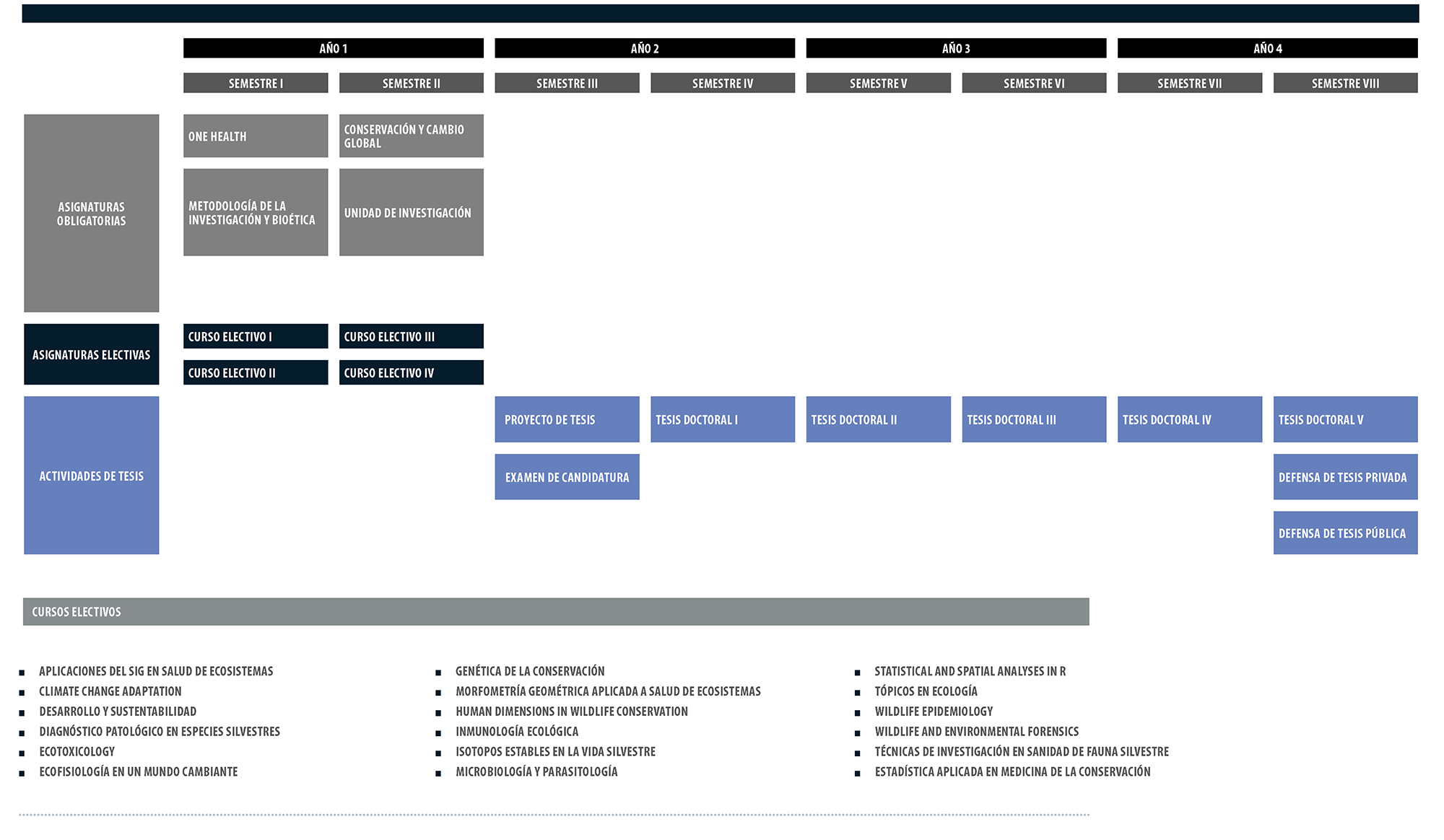
Program Curriculum
Ph.D. Program Professors
Rubén Avendaño
Ph.D. in Biology, specializing in Fish Microbiology and Parasitology, University of Santiago de Compostela, Spain
Research Area: One Health.
ravendano@unab.cl See moreClaudio Azat
Ph.D. in Conservation Medicine, Universidad Andrés Bello and the Zoological Society of London, Chile/United Kingdom
Research Areas: biodiversity conservation, wildlife epidemiology, and emerging diseases.
claudio.azat@unab.cl See moreOlga Barbosa
Ph.D. in Ecology, Pontifical Catholic University of Chile
Research Areas: ecosystem ecology, biodiversity conservation, and socioecology.
olga.barbosa@unab.cl See moreHugo Benítez
Ph.D. in Evolutionary Biology, University of Manchester, United Kingdom
Research Areas: evolutionary biology, invasion biology, ecomorphology, and geometric morphometrics.
hugo.benitez@unab.cl See moreFrancisca Blanco
Ph.D. in Biological Sciences, specializing in Molecular Genetics and Microbiology, Pontifical Catholic University of Chile
Research Area: plant immune responses in plant-insect interactions.
mblanco@unab.cl See moreCristian Bulboa
Ph.D. in Sciences, specializing in Botany, University of São Paulo, Brazil
Research Areas: marine algal biology and reproduction; applied phycology for cultivation and restocking.
cbulboa@unab.cl See moreMauricio Carter
Ph.D. in Sciences, specializing in Ecology and Evolutionary Biology, University of Chile
Research Areas: thermal ecology, ecophysiology, and freshwater ecosystem ecology.
mauricio.carter@unab.cl See moreMauricio Coppo
Ph.D. in Veterinary Virology and Avian Immunology, University of Melbourne, Australia
Research Areas: antimicrobial resistance; implementation of One Health in low- and middle-income countries; veterinary microbiology and virology; and avian immunology.
mauricio.coppo@unab.cl See morePablo Cruces
Physician and Surgeon, University of Concepción. Pediatrician, Pontifical Catholic University of Chile. Pediatric Intensivist, Universidad del Desarrollo, Chile.
Research Areas: acute respiratory failure, intensive care, pediatrics, mechanical ventilation, and respiratory viruses.
pablo.cruces@unab.cl See moreCristian Duarte
Ph.D. in Sciences, specializing in Systematics and Ecology, Austral University of Chile
Research Area: Global Change.
cristian.duarte@unab.cl See moreGustavo Gatica
Ph.D. in Engineering Sciences, specializing in Automation, University of Santiago de Chile
Research Areas: mathematical model design and solution; data analysis using emerging technologies, including deep learning and AI.
ggatica@unab.cl See moreCarlos González
Ph.D. in Pathology, University of Edinburgh, United Kingdom
Research Areas: comparative pathology in models of respiratory, oncologic, and immune-mediated diseases; veterinary forensic pathology at the human-animal-environment interface.
carlosgonzalez@unab.cl See moreChristian Ibáñez
Ph.D. in Sciences, specializing in Ecology and Evolutionary Biology, University of Chile
Research Areas: genetics and evolution, phyloinformatics, and biodiversity.
christian.ibanez@unab.cl See moreGonzalo Medina
Ph.D. in Wildlife Ecology, Lincoln University, New Zealand
Research Areas: conservation biology, wildlife ecology, and the ecology of infectious diseases in wildlife.
gmedina@unab.cl See moreEdmundo Muñoz
Ph.D. in Engineering, University of La Frontera, Chile
Research Areas: life cycle assessment, circular economy, and urban sustainability.
edmundo.munoz@unab.cl See morePablo Oyarzún
Ph.D. in Marine Biology, Austral University of Chile
Research Areas: marine biology, marine reproductive biology, and aquaculture.
pablo.oyarzun@unab.cl See moreMaría Cecilia Pardo
Ph.D. in Sciences, specializing in Ecology and Evolutionary Biology, University of Chile
Research Areas: biogeography, phylogeny, marine genetics and evolution, and ecomorphology.
pardogandarillas@gmail.com See moreRodolfo Paredes
Ph.D. in Biomedical Sciences, University of Chile
Research Areas: host-parasite immune interactions; development of medical devices for histotypic tissue repair.
rparedes@unab.cl See moreJosé Miguel Pulgar
Ph.D. in Biological Sciences, specializing in Ecology, Pontifical Catholic University of Chile
Research Areas: coastal ecology and anthropogenic impacts on biodiversity.
jpulgar@unab.cl See moreVerónica Quirici
Ph.D. in Biological Sciences, specializing in Ecology, Pontifical Catholic University of Chile
Research Areas: behavioral ecology and anthropogenic effects on wildlife.
rosina.quirici@unab.cl See moreClaudia Saavedra
Ph.D. in Biochemistry, University of Chile
Research Areas: molecular microbiology of pathogenic bacteria and antimicrobial resistance; One Health, including microbiomes, molecular surveillance, and public health; microbial ecology; and biotechnology in extreme environments.
csaavedra@unab.cl See moreGisela Stotz
Ph.D. in Ecology, University of Alberta, Canada
Research Areas: plant ecology, biological invasions, and functional ecology.
gisela.stotz@unab.cl See morePamela Thomson
Ph.D. in Biomedicine, Universitat Rovira i Virgili, Spain
Research Areas: One Health.
pamela.thomson@unab.cl See moreJuliana Vianna
Ph.D. in Ecology, Pontifical Catholic University of Chile
Research Areas: evolutionary biology and vertebrate population and adaptive genomics.
juliana.vianna@unab.cl See moreCollaborating Faculty
Aiko Adell
Ph.D. in Comparative Pathology, University of California, Davis, United States
Research Line: Microbial Biotechnology
Francisca Astorga
Ph.D. in Conservation Medicine, Universidad Andrés Bello
Daniela Doussang
Ph.D. in Veterinary Sciences, University of Concepción
Cayetano Espinosa
Ph.D. in Conservation Medicine, Universidad Andrés Bello
José Manuel Estrada
Ph.D. in Biotechnology, Universidad Andrés Bello
Ivan Franchi
Ph.D. in Geography, Territorial Planning, and Environmental Management, University of Barcelona
Elizabeth Garrido
Ph.D. in Natural Resources Sciences, University of La Frontera
Sebastián Klarián
Ph.D. in Conservation Medicine, Universidad Andrés Bello
Gabriel León
Ph.D. in Biological Sciences, specializing in Cell and Molecular Biology, Pontifical Catholic University of Chile
Beatriz Mella
Ph.D. in Urban Planning, University College London
Daniel Pons
Ph.D. in Mathematics, Imperial College London, University of London, United Kingdom
Alejandro Simeone
Ph.D. in Natural Sciences, Christian-Albrechts-Universität zu Kiel, Germany
asimeone@unab.cl See moreJuan Ugalde
Ph.D. in Marine Biology, University of California, San Diego, United States
Leonardo Vera
Ph.D. in Natural Resources Sciences, University of La Frontera
Visiting Faculty
Pelayo Acevedo
Institute for Game and Wildlife Research, Spain
Karina Acevedo-Whitehouse
Autonomous University of Querétaro, Mexico
Julio Benavides
French National Research Institute for Sustainable Development (IRD), France
Andrew Cunningham
Institute of Zoology, Zoological Society of London, United Kingdom
Luis Escobar
Department of Fish and Wildlife Conservation, Virginia Tech, United States
Arno Gutleb
Luxembourg Institute of Science and Technology (LIST), Luxembourg
Javier Millán
Agri-Food Institute of Aragon (IA2), University of Zaragoza, Spain
John Organ
U.S. Geological Survey, United States
María Soledad Sepúlveda
Department of Forestry and Natural Resources, Purdue University, United States
Paul Wagner
College of Natural Resources and Environment, Center for Leadership in Global Sustainability, United States
Requirements
Applicants to the Ph.D. in Conservation Medicine must hold a bachelor’s or master’s degree in the basic sciences, health sciences, environmental sciences, or a related field, such as biology, ecology, veterinary medicine, marine biology, agronomy, forestry engineering, environmental engineering, or public health. Applicants may also hold a professional degree whose level, content, and duration are equivalent to a bachelor’s degree awarded by the university.
A. Application Requirements
Applicants must submit the following documents:
- Application Form (see template). Download and complete the form with the requested information.
- Notarized copy of the academic degree certificate*
- Official undergraduate transcript
- Undergraduate class rank
- If the applicant has completed graduate studies, include a notarized copy of the degree certificate and the corresponding transcript.
- Copy of the national identity card (front and back) or a digital birth certificate. International applicants who do not have a Chilean identity card may submit a copy of their passport.
- Curriculum vitae (CV)
- Statement of purpose describing the applicant’s interests and reasons for applying to this program at Universidad Andrés Bello.
- Two letters of recommendation, sent directly by the recommenders from their email addresses to ana.torres@unab.cl.
* Academic degrees earned outside Chile must be equivalent to those specified in the program’s governing decree. Applicants who are admitted must submit all documentation required by the university to the Ph.D. program office before completing enrollment.


 contact us