
Ph.D. in
Physical Sciences



Degree
Ph.D. in Physical Sciences

Duration
8 Semesters

Faculty
Exact Sciences

2027 Admission
The 2027 admissions process for this Ph.D. program closed on October 4.
Overview
The Ph.D. in Physical Sciences program is the result of a collaborative effort between researchers from the Department of Physics and Astronomy in the Faculty of Exact Sciences at Universidad Andrés Bello (UNAB) and researchers from the Center for Research at the Intersection of Plasma Physics, Matter, and Complexity and the Center for Research in Nuclear Physics and Neutron Spectroscopy, both part of the Chilean Nuclear Energy Commission (CCHEN).
It was founded on the shared conviction of its members that fostering advanced human capital and promoting research across the various areas of physics are central to their mission. The program also supports the Faculty’s mission: “To develop and disseminate scientific knowledge, train highly qualified human capital in the disciplines pursued within the Faculty, and provide foundational scientific knowledge for the University’s future professionals, in accordance with the guidelines of the Educational Model, thereby contributing to the country’s scientific, technological, and social development.”
Objectives
Graduate Profile
Graduates of the Ph.D. in Physical Sciences program at Universidad Andrés Bello have a strong foundation in physics and advanced knowledge in one of the program’s research areas: High-Energy Physics and Gravitation, Particle Physics, Condensed Matter Physics, or Plasma Physics. They have also mastered the theoretical and methodological foundations of scientific research. They use physics-based, mathematical, and computational tools to understand and formulate the laws that describe physical phenomena. They apply theoretical and experimental methods to solve scientific and technological problems independently or collaboratively, contributing to the creation of new knowledge.
Program Research Areas
High-Energy Physics and Gravitation
Particle Physics
Condensed Matter Physics
Plasma Physics
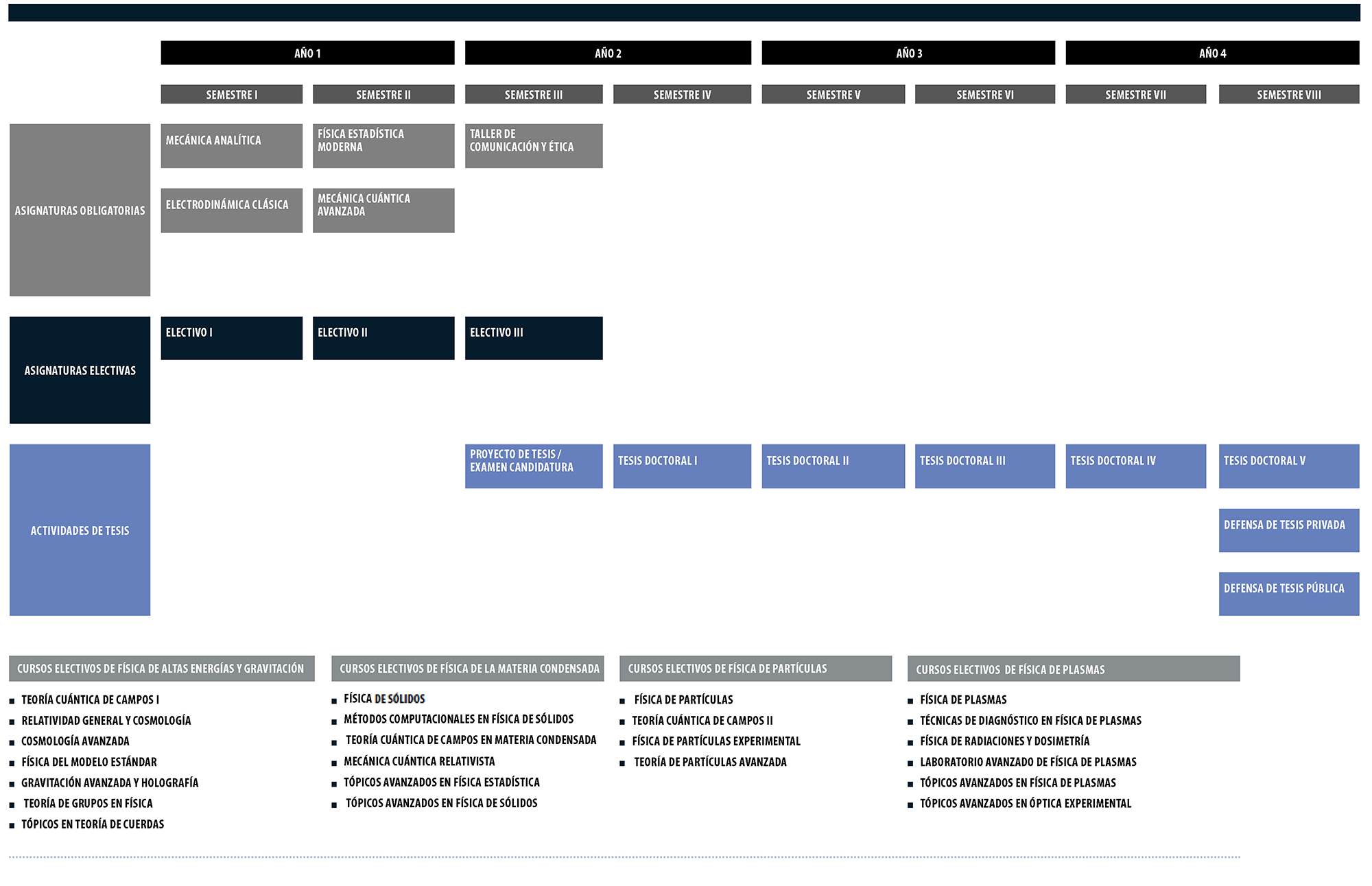
Program Curriculum
Ph.D. Program Professors
Ignacio Araya
Ph.D. in Physics, University of Southern California, Estados Unidos
Research Interests: High energy physics, Gravitation, AdS/CFT holography, AdS gravity, Primordial black holes.
ignacio.araya@unab.cl See moreRodrigo Aros
PhD in Physical Science, University of Chile
Research Areas: High-energy physics, gravitation, AdS/CFT correspondence, alternative theories of gravity.
raros@unab.cl See moreMarco Ayala
PhD in Physics, National Polytechnic Institute, Mexico
Research Areas: Particle physics, simulation and data analysis, detector electronics.
marco.ayala@unab.cl See moreBiswajit Bora (CCHEN)
PhD in Physics, Gauhati University, India
Research Areas: Plasma physics, materials science, energy transition.
bbora@cchen.cl See moreMauro Cambiaso
PhD in Exact Sciences, Pontifical Catholic University of Chile
Research Areas: Theoretical particle and field physics, extensions of the Standard Model of particle physics, topological field theories, radiation-matter interactions with topological phases.
mcambiaso@unab.cl See moreSergio Davis (CCHEN)
PhD in Applied Physics, Royal Institute of Technology, Sweden
Research Areas: Statistical mechanics, materials physics, probability and information theory, plasma physics.
sergio.davis@cchen.cl See moreJalaj Jain (CCHEN)
PhD in Applied Sciences, University of Talca, Chile
Research Areas: Plasma physics, radiation generation and measurement, interaction of radiation with living matter.
jalaj.jain@cchen.cl See moreSergey Kovalenko
PhD in Physical and Mathematical Sciences, Joint Institute for Nuclear Research, Russia
Research Areas: Theoretical elementary particle physics, electroweak interactions, physics beyond the Standard Model, supersymmetry phenomenology.
sergey.kovalenko@unab.cl See moreSergey Kuleshov
PhD in Physical and Mathematical Sciences, Institute for Theoretical and Experimental Physics, Russia
Research Areas: High-energy physics, experimental nuclear physics, elementary particle physics.
sergey.kuleshov@unab.cl See moreMacarena Lagos
PhD in Physics, Imperial College London, United Kingdom
Research Areas: High-energy physics, gravitation, cosmology, gravitational waves, dark energy.
macarena.lagos.u@unab.cl See moreRodrigo López (CCHEN)
PhD in Physical Science, University of Chile
Research Areas: Plasma physics, space plasmas, plasma kinetic theory.
rodrigo.lopez@cchen.cl See moreClaudia Loyola
PhD in Physical Science, University of Chile
Research Areas: Solid-state physics, structural and vibrational properties of materials, computational physics.
claudia.loyola@unab.cl See moreLeopoldo Mejía
PhD in Chemistry, University of Rochester, United States
Research Areas: Many-body quantum systems, transport in quantum systems.
leopoldo.mejia@unab.cl See moreFrancisco Molina (CCHEN)
PhD in Nuclear Physics, University of Valencia, Spain
Research Areas: Experimental nuclear physics, nuclear structure, nuclear astrophysics, neutron field studies, time dependence in Monte Carlo reactor simulations.
francisco.molina@cchen.cl See moreJosé Moreno (CCHEN)
PhD in Exact Sciences, Pontifical Catholic University of Chile
Research Areas: Plasma physics, nuclear fusion, ionizing radiation.
jose.moreno@cchen.cl See moreWalter Orellana
PhD in Physical Sciences, University of São Paulo, Brazil
Research Areas: Condensed matter physics, computational materials science, electronic structure, heterogeneous catalysis, and energy conversion.
worellana@unab.cl See moreCristián Pavez (CCHEN)
PhD in Physical Sciences, University of Concepción, Chile
Research Areas: Plasma physics, Fourier optics and holography, plasma diagnostic techniques, pulsed power.
cristian.pavez@cchen.cl See moreJoaquín Peralta
PhD in Physical Science, University of Chile
Research Areas: Solid-state physics, structural and vibrational properties of materials, computational physics.
joaquin.peralta@unab.cl See moreSebastián Reyes-Lillo
PhD in Physics, Rutgers University, United States
Research Areas: Condensed matter physics, first-principles methods, ferroelectricity, solar energy conversion.
sebastian.reyes@unab.cl See moreLeopoldo Soto (CCHEN)
PhD in Exact Sciences, Pontifical Catholic University of Chile
Research Areas: Plasma physics, pulsed power, applied optics, effects of intense pulsed radiation on organic and biological matter.
leopoldo.soto@cchen.cl See moreBrenno Vallilo
PhD in Theoretical Physics, São Paulo State University, Brazil
Research Areas: String theory, supersymmetry, AdS/CFT correspondence.
vallilo@unab.cl See moreJilberto Zamora
PhD in Physical Science, Federico Santa María Technical University, Chile
Research Areas: Particle physics phenomenology, neutrinos, and dark matter; experimental particle physics and detector development.
jilberto.zamora@unab.cl See moreCollaborating Faculty
Mauricio Contreras
PhD in Physical Science, University of Chile
Research Areas: General relativity, field theory, econophysics.
mauricio.contreras.g@unab.cl See moreRequirements
The Ph.D. in Physical Sciences program is intended for applicants who hold a bachelor’s or master’s degree in physics or engineering physics and are interested in acquiring advanced knowledge in theoretical or experimental physics or a related discipline, with the aim of making original, independent contributions to knowledge.
A. Application Requirements
The applicant must submit the following documents:
- Application Form (see below). Download and complete the form with the requested information.
- Notarized copy (apostille authentication) of the degree certificate*
- Official undergraduate transcript
- Undergraduate class rank
- If you have completed graduate studies, include a notarized copy (apostille authentication) of the degree certificate and the corresponding transcript.
- Copy of the national identity card (both sides) or digital birth certificate; international applicants without a Chilean identity card may submit a copy of their passport.
- Letter describing your interests and reasons for applying to this program at Universidad Andrés Bello.
- Two letters of recommendation, each sent directly by the recommender from their email address to liaraya@unab.cl and doctorado.csfisicas@unab.cl (see template).
- Online interview during which you will be asked about your motivation, interests, and previous research activities. You may also be asked questions about undergraduate-level physics.
* Academic degrees earned outside Chile must be equivalent to those specified in the program’s governing decree. Selected applicants must submit all documentation required by the University to the Doctoral Program Office in order to complete the enrollment process.


 contact us