
Ph.D. in
Biomedicine


2027 Admission
Apply by September 4, 2026. Check the Requirements section.
Overview
The Ph.D. in Biomedicine was established and is administered by the Institute of Biomedical Sciences within the School of Medicine at Universidad Andrés Bello, in keeping with the Institute’s mission: “to conduct research and provide graduate education at the highest level of excellence in the sciences, with particular emphasis on biomedical sciences, positioning the University as one of the country’s leading institutions in this important field of knowledge.” This program advances the Institute’s mission by helping develop advanced human capital, fostering the generation of new knowledge, and strengthening Universidad Andrés Bello’s position nationally and internationally.
General Objective
The Ph.D. in Biomedicine provides advanced, up-to-date education in biomedical sciences by integrating knowledge from various areas of the biological sciences and human health and fostering scientific research in these fields. In this way, the program helps train researchers with the skills needed to address current and future challenges in biomedicine, contributing to society and to the advancement of scientific knowledge in the field.
Specific Objectives
The specific objectives of the program are:
- Provide excellent Ph.D.-level education that enables graduates to independently generate original scientific knowledge in biomedical sciences in one of the following research lines: Cellular and Molecular Bases of Metabolic Diseases; Stem Cell Biology, Cell Reprogramming, and Transdifferentiation; Neuroscience and Nervous System Diseases; and Cell Signaling in Pathophysiology, while complying with ethical and bioethical protocols and standards.
- Provide opportunities for students to acquire advanced theoretical and practical knowledge in biomedical sciences, as well as leadership skills that enable them to contribute to the advancement of biomedical research.
- Provide opportunities for students to develop the skills needed to communicate, in writing and orally, the findings of their biomedical research to specialist and general audiences.
Graduate Profile
Graduates of the Ph.D. in Biomedicine program at Universidad Andrés Bello are advanced-level researchers with specialized theoretical and practical knowledge and skills in biomedical sciences, a solid foundation in the concepts and principles of biomedical research, an understanding of its scope and current state, and insight into its applications to precision medicine.
Upon completing the program, graduates of the Ph.D. in Biomedicine will be able to demonstrate the following learning outcomes:
- Demonstrate advanced theoretical and practical knowledge in biomedical sciences by conducting independent, original research that contributes to one of the program’s research lines: Cellular and Molecular Bases of Metabolic Diseases; Stem Cell Biology, Cell Reprogramming, and Transdifferentiation; Neuroscience and Nervous System Diseases; and Cell Signaling in Pathophysiology.
- Generate new knowledge by designing and conducting research projects in one of the program’s research lines, considering applications to precision medicine, complying with ethical and bioethical standards, and demonstrating leadership skills.
- Communicate, in writing and orally, the findings of their biomedical research to specialist and general audiences, in accordance with the standards of the discipline or field of study.
Program Research Area
This research line examines the cellular and molecular mechanisms that regulate cellular function in the body under normal and pathological conditions. It focuses on diseases caused by pathogens and metabolic abnormalities, a broad group of inherited or acquired conditions resulting from disruptions to various biochemical processes.
This research line examines the cellular and molecular mechanisms that regulate cell differentiation, the pathophysiological processes in which changes in cell identity alter normal function, and the potential of reprogramming adult stem cells for personalized treatment of various conditions affecting humans.
This research line examines different aspects of nervous system function and structure, with emphasis on the cellular and molecular mechanisms of memory, learning, and motor function, among others, as well as conditions associated with neurodevelopment, such as autism, and neurodegeneration, such as Alzheimer’s disease, Parkinson’s disease, and amyotrophic lateral sclerosis.
This research line examines the mechanisms associated with signaling pathways that coordinate cellular function and the integrated response of different tissues in the body, as well as how disruptions to these signaling mechanisms lead to various diseases.
Cellular and Molecular Bases of Metabolic Diseases
This research line examines the cellular and molecular mechanisms that regulate cellular function in the body under normal and pathological conditions. It focuses on diseases caused by pathogens and metabolic abnormalities, a broad group of inherited or acquired conditions resulting from disruptions to various biochemical processes.
Stem Cell Biology, Cell Reprogramming, and Transdifferentiation
This research line examines the cellular and molecular mechanisms that regulate cell differentiation, the pathophysiological processes in which changes in cell identity alter normal function, and the potential of reprogramming adult stem cells for personalized treatment of various conditions affecting humans.
Neuroscience and Nervous System Diseases
This research line examines different aspects of nervous system function and structure, with emphasis on the cellular and molecular mechanisms of memory, learning, and motor function, among others, as well as conditions associated with neurodevelopment, such as autism, and neurodegeneration, such as Alzheimer’s disease, Parkinson’s disease, and amyotrophic lateral sclerosis.
Cell Signaling in Pathophysiology
This research line examines the mechanisms associated with signaling pathways that coordinate cellular function and the integrated response of different tissues in the body, as well as how disruptions to these signaling mechanisms lead to various diseases.
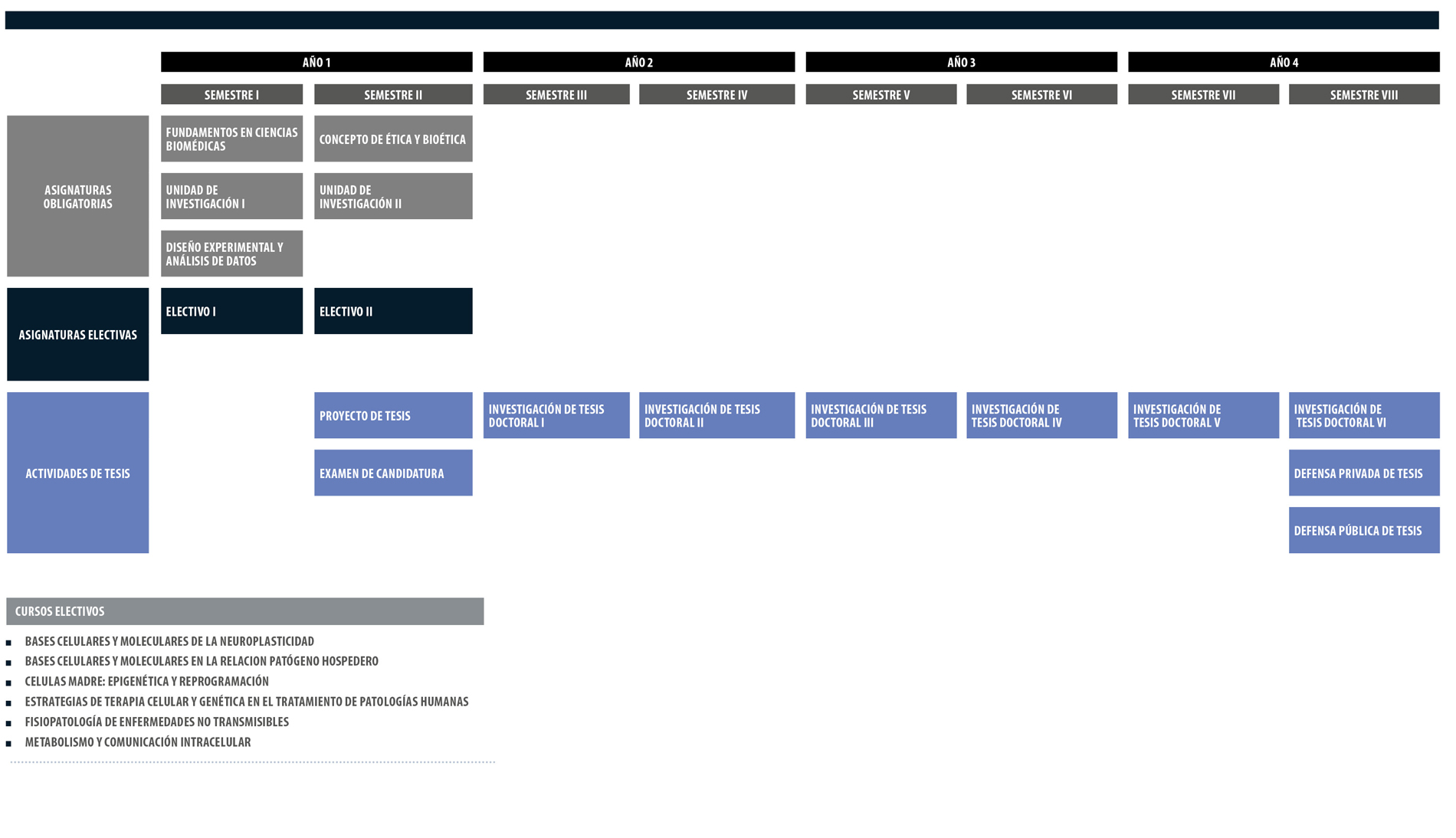
Program Curriculum
Ph.D. Program Professors
Rodrigo Aguilar
Ph.D. in Molecular Biosciences, Universidad Andrés Bello, Chile
Research Lines: Cellular and molecular bases of metabolic diseases. Stem cell biology, cell reprogramming, and transdifferentiation
rodrigo.aguilar@unab.cl See moreGloria Arriagada
Ph.D. in Biological Sciences, University of Concepción, Chile
Research Lines: Cellular and molecular bases of metabolic diseases; Cell Signaling in Pathophysiology
gloria.arriagada@unab.cl See moreCarlos Blondel
Ph.D. in Biochemistry, University of Chile
Research Lines: Cellular and molecular bases of metabolic diseases
carlos.blondel@unab.cl See moreFrancisca Bronfman
Ph.D. in Medical Sciences, Université Catholique de Louvain, Belgium
Research Lines: Neuroscience and nervous system diseases; Cell Signaling in Pathophysiology
francisca.bronfman@unab.cl See moreFernando Bustos
Ph.D. in Cellular and Molecular Biology, University of Concepción, Chile
Research Lines: Neuroscience and nervous system diseases
fernando.bustos@unab.cl See moreÁlvaro Elorza
Ph.D. in Biological Sciences with a specialization in Cellular and Molecular Biology, Pontifical Catholic University of Chile / Ph.D. in Biology and Health, Université Victor Segalen Bordeaux 2, France
Research Lines: Cellular and molecular bases of metabolic diseases; Stem cell biology, cell reprogramming, and transdifferentiation
alvaro.elorza@unab.cl See moreCarmen Gloria Feijoo
Ph.D. in Molecular Biosciences, Universidad Andrés Bello, Chile
Research Line: Cell Signaling in Pathophysiology
cfeijoo@unab.cl See moreMartín Montecino
Ph.D. in Biomedical Sciences, University of Massachusetts, United States
Research Lines: Cellular and molecular bases of metabolic diseases; Stem cell biology, cell reprogramming, and transdifferentiation
mmontecino@unab.cl See moreCarolina Otero
Ph.D. in Immunology, University of Konstanz, Germany
Research Line: Cellular and molecular bases of metabolic diseases
maria.otero@unab.cl See moreClaudia Riedel
Ph.D. in Pharmacology, Albert Einstein College of Medicine of New York, United States
Research Lines: Cellular and molecular bases of metabolic diseases; Cell Signaling in Pathophysiology
claudia.riedel@unab.cl See moreMaría Alejandra San Martín
Ph.D. in Biological Sciences with a specialization in Cellular and Molecular Biology, Pontifical Catholic University of Chile
Research Lines: Cellular and molecular bases of metabolic diseases. Cell Signaling in Pathophysiology
maria.sanmartin@unab.cl See moreJimmy Stehberg
Ph.D. in Life Sciences, Weizmann Institute of Sciences, Israel
Research Lines: Neuroscience and nervous system diseases
jstehberg@unab.cl See moreFelipe Simón
Ph.D. in Biomedical Sciences, University of Chile
Research Line: Cell Signaling in Pathophysiology
fsimon@unab.cl See moreBrigitte van Zundert
Ph.D. in Biological Sciences, Cellular and Molecular Biology Area, University of Concepción, Chile
Research Lines: Stem cell biology, cell reprogramming, and transdifferentiation. Neuroscience and nervous system diseases
bvanzundert@unab.cl See moreLorena Varela-Nallar
Ph.D. in Biological Sciences with a specialization in Cellular and Molecular Biology, Pontifical Catholic University of Chile
Research Lines: Stem cell biology, cell reprogramming, and transdifferentiation. Neuroscience and nervous system diseases
lorena.varela@unab.cl See moreCollaborating Faculty
Verónica Burzio
Ph.D. in Sciences with a specialization in Molecular and Cellular Biology and Neuroscience, University of Chile
Paulina Rojas
Ph.D. in Pharmacology, University of Chile
Hugo Sepúlveda
Ph.D. in Molecular Biosciences, Universidad Andrés Bello, Chile
Requirements
A. Application requirements
Applicants to the Ph.D. in Biomedicine must hold a master’s or bachelor’s degree in biological sciences, health sciences, or another biomedical science.
The applicant must submit the following documents:
- Application Form (see below). Download and complete the form with the requested information.
- Notarized copy of the academic degree*
- Undergraduate transcript
- Undergraduate class rank**
- If you have completed graduate studies, attach a notarized copy of the degree and the corresponding transcript.
- Copy of the National ID Card (both sides) or digital Birth Certificate; international applicants without a National ID Card may submit a copy of their passport.
- Curriculum Vitae (see format)
- Letter describing your interests and the reasons you wish to apply to this program and Universidad Andrés Bello (see template)
- Two recommendation letters sent directly by each recommender from their email address to carlos.blondel@unab.cl (see template).
** Academic degrees issued by foreign institutions must be equivalent to those specified in the program decree. If selected, the applicant must submit to the Ph.D. Program Office all documentation required by the University before enrollment can proceed.
** An undergraduate class-rank certificate for the applicant’s graduating class or degree cohort that explicitly states the applicant’s rank and the total number of graduates in that class or cohort. Rankings based on the total number of students admitted to the undergraduate program are not accepted.

 Postula Aquí