
Ph.D. in
Astrophysics




Degree
Ph.D. in Astrophysics

Duration
8 semesters

Faculty
Exact Sciences
2027 Admissions
The 2027 admissions process for this Ph.D. program closed on September 4.
Presentation
The Ph.D. in Astrophysics was established through the collaborative efforts of astronomy faculty researchers from the Department of Physics and Astronomy and the Institute of Astrophysics in the Faculty of Exact Sciences. Its creation reflects the Faculty of Exact Sciences’ mission: “To develop and disseminate scientific knowledge, train advanced human capital in the disciplines in which it specializes, and provide a strong foundation in the basic sciences for the university’s future professionals, in accordance with the principles of its educational model, thereby contributing to the country’s scientific, technological, and social development.”
This program reflects the program faculty’s commitment to advancing human capital development and research across the various fields of astrophysics. A significant contribution to this field, which enjoys well-recognized comparative advantages in Chile, including access to international observatories equipped with state-of-the-art technology and world-class scientific instrumentation.
General Objective
The objective of the Ph.D. in Astrophysics is to provide an outstanding doctoral education that prepares graduates to conduct original, independent research whose results make a significant contribution to the field of astronomy. In doing so, the program contributes to the advancement of science and the country’s development by leveraging Chile’s comparative advantages, including access to international astronomical observatories equipped with state-of-the-art instrumentation
Specific Objectives
- Develop critical thinking that is fundamental to the scientific method through advanced knowledge of the theories and methods underlying the Program’s research lines, as well as the state of the art in astronomy.
- Formulate and solve significant and complex scientific problems through a strong command of the field’s theoretical and methodological foundations.
- Prepare students to develop original research that advances the field of astrophysics, while fostering their active participation in scientific collaborations in astrophysics and related disciplines.
- Contribute to the generation of knowledge at the frontiers of astronomy that advances the understanding and development of the discipline at both the national and international levels, guided by responsibility and ethical principles.
Graduate Profile
Graduates of the Ph.D. in Astrophysics at Universidad Andrés Bello are independent researchers with a strong foundation of knowledge, skills, and competencies to address scientific questions in astrophysics, including data modeling and analysis; the formation, evolution, and structure of the universe; and the fundamental physical processes that govern the formation and evolution of objects ranging from planets and stars to galaxies, galaxy clusters, and the large-scale structure of the universe.
Graduates possess specialized, up-to-date training that enables them to conduct original research using advanced analytical and critical thinking skills, contributing to the generation of new knowledge in the field of astrophysics through the Program’s research lines in Stellar Astrophysics, Extragalactic Astrophysics, and Cosmology.
Graduates of the program have acquired the skills to communicate the results of their research and to participate in research teams within academic institutions, observatories, and research centers.
Research Lines
This research line focuses on the characterization of the physical processes that govern the formation, evolution, and structure of exoplanets, substellar and stellar objects and systems, and their relationship to the interstellar medium and our Galaxy.
This research line focuses on the characterization of the structure and evolution of galaxies and their various components, as well as the formation and evolution of galaxy groups and clusters.
This research line focuses on the measurement of cosmological parameters, the large-scale structure of the universe, dark matter and dark energy, and the characterization of the different stages in the evolution of the universe.
Stellar Astrophysics
This research line focuses on the characterization of the physical processes that govern the formation, evolution, and structure of exoplanets, substellar and stellar objects and systems, and their relationship to the interstellar medium and our Galaxy.
Extragalactic Astrophysics
This research line focuses on the characterization of the structure and evolution of galaxies and their various components, as well as the formation and evolution of galaxy groups and clusters.
Cosmology
This research line focuses on the measurement of cosmological parameters, the large-scale structure of the universe, dark matter and dark energy, and the characterization of the different stages in the evolution of the universe.
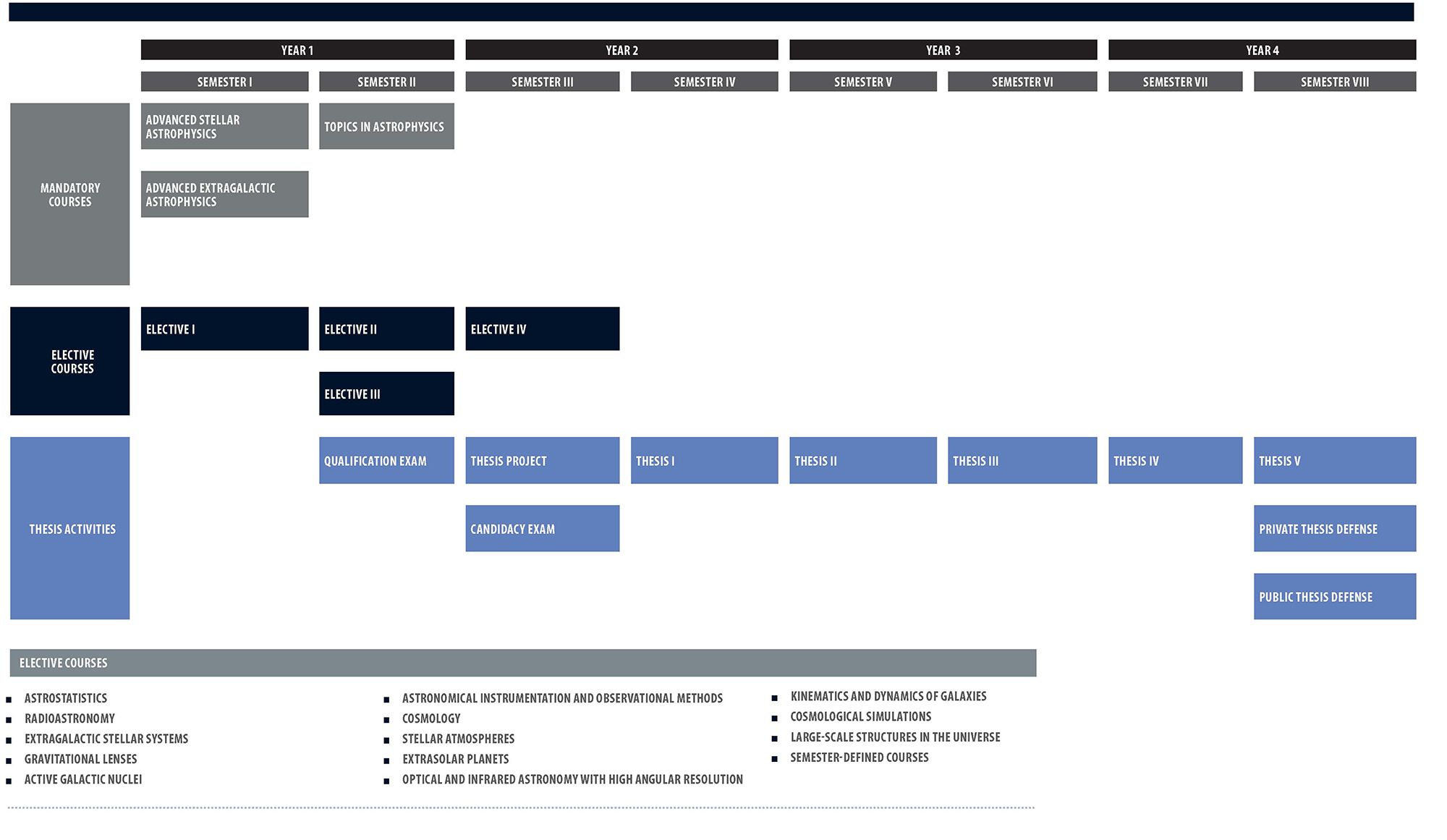
Program Curriculum
Program Faculty
Timo Anguita
Ph.D. in Astronomy, Universitaet Heidelberg, Alemania
Research Interests: Gravitational lenses. Active galactic nuclei. Massive galaxies.
timo.anguita@unab.cl See moreIgnacio Araya
Ph.D. in Physics, University of Southern California, Estados Unidos
Research Interests: High energy physics, Gravitation, AdS/CFT holography, AdS gravity, Primordial black holes.
ignacio.araya@unab.cl See moreMaría Celeste Artale
Ph.D. in Physics, Universidad de Buenos Aires, Argentina
Research Interests: Galaxy formation and evolution. Cosmological simulations. X-ray binaries. Gravitational-wave astrophysics.
maria.artale@unab.cl See moreClaudio Cáceres
Ph.D. in Astronomy, Pontificia Universidad Católica de Chile
Research Interests: Stellar Astrophysics. Formation and early evolution of exoplanets and sub-stellar objects. Circumstellar disks. Extrasolar planets.
claudio.caceres@unab.cl See moreRicardo Demarco
Ph.D. in Astrophysics, Université Paris-VII (Denis Diderot), Francia
Research Interests: Formation and evolution of galaxies and large-scale structures in the universe.
ricardo.demarco@unab.cl See moreBruno Dias
Ph.D. in Astrophysics, Universidade de São Paulo, Brasil
Research Interests: Magellanic Clouds. Star clusters. Stellar populations.
bruno.dias@unab.cl See moreScarlet Elgueta
Ph.D. in Astronomy, The University of Tokyo, Japón
Research Interests: Medium-to-high resolution spectroscopy. Stellar astrophysics. Galactic archaeology. Laboratory astrophysics.
scarlet.saez@unab.cl See moreIsabelle Gavignaud
Ph.D. in Astrophysics, Université Toulouse III - Paul Sabatier, Francia.
Research Interests: Evolution of active galactic nuclei (AGN) and their host galaxies.
igavignaud@unab.cl See moreMatías Gómez
Ph.D. in Physics, Pontificia Universidad Católica de Chile
Research Interests: Globular cluster systems. Extragalactic star clusters. Compact stellar associations.
matiasgomez@unab.cl See moreLucia Guaita
Ph.D. in Astronomy, Pontificia Universidad Católica de Chile
Research Interests: Star-forming galaxies. Galaxy evolution.
lucia.guaita@unab.cl See moreMacarena Lagos
Ph.D. in Physics, Imperial College London, Reino Unido
Research Interests: Gravitational waves. Dark energy. Dark matter. Black holes.
macarena.lagos.u@unab.cl See moreDante Minniti
Ph.D. in Astronomy, University of Arizona, Estados Unidos
Research Interests: Globular clusters and the Milky Way. Stellar populations, variability, and evolution. Extrasolar planets and gravitational microlensing.
dante.minniti@unab.cl See moreLorenzo Monaco
Ph.D. in Astronomy, Università di Bologna, Italia
Research Interests: Resolved stellar populations. Metal-poor stars. High-resolution spectroscopy.
lorenzo.monaco@unab.cl See moreJulie Nantais
Ph.D. in Astronomy, Harvard University, Estados Unidos
Research Interests: Galaxy groups and clusters. Galaxy evolution (observational). Formation of elliptical and lenticular galaxies.
julie.nantais@unab.cl See moreKeiichi Onaka
Ph.D. in Astronomy, University of Tokyo, Japón
Research Interests: High-spatial-resolution observations. Evolved stars. Stellar surface structures.
keiichi.onaka@unab.cl See moreSandro Villanova
Ph.D. in Astronomy, Università di Padova, Italia
Research Interests: Star clusters. Chemical abundances. Extrasolar planets.
sandro.villanova@unab.cl See moreVisiting Faculty
Yuri Beletsky
Nicola Masetti
Requirements
A. Admission requirements
Applicants must complete the application form and upload a single PDF file containing the following documents, in the exact order indicated below:
- A statement of purpose letter outlining the applicant’s motivations for pursuing the program.
- Official undergraduate transcript.
- Curriculum vitae (including a list of peer-reviewed publications and conference presentations).
- Official graduate transcript, if applicable.
In addition, applicants must arrange for two letters of recommendation to be sent directly to astrodoc@unab.cl no later than September 4, the application deadline.
B. Application Procedure
The application must be submitted online using the following form:


 contact us